 Rocksday
Lapis Lazuli vs Lazurite
How to tell them apart
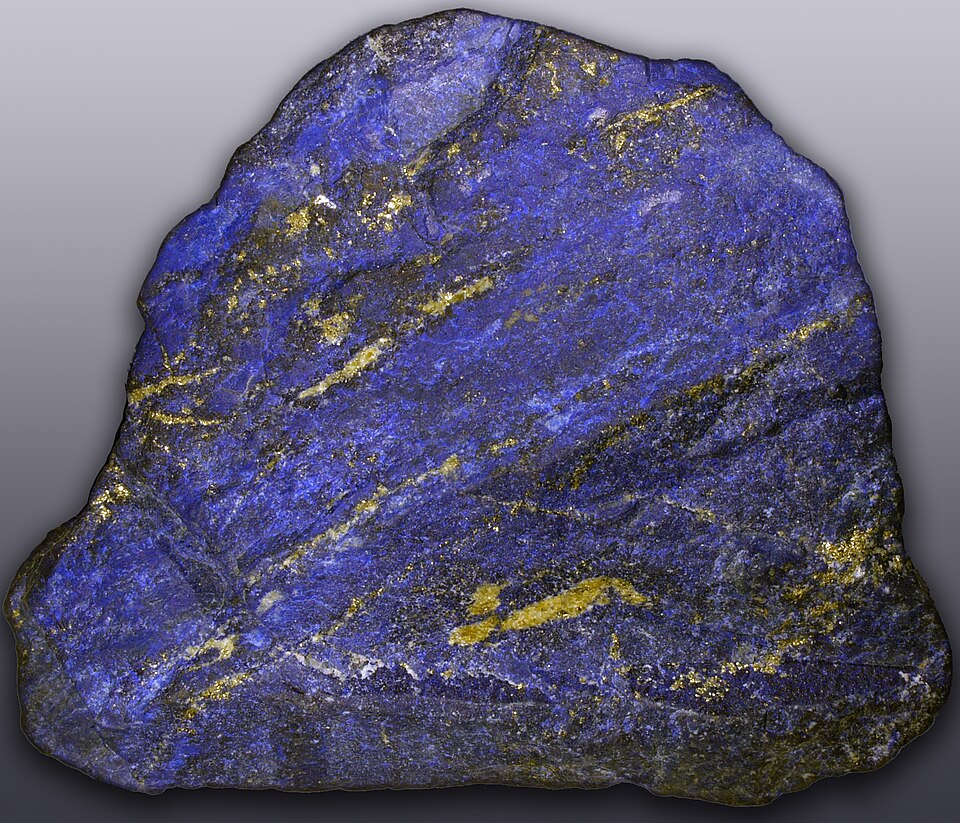
A deep-blue rock made mostly of the mineral lazurite, flecked with golden pyrite and white calcite.
Photo: Hannes Grobe, CC BY-SA 2.5
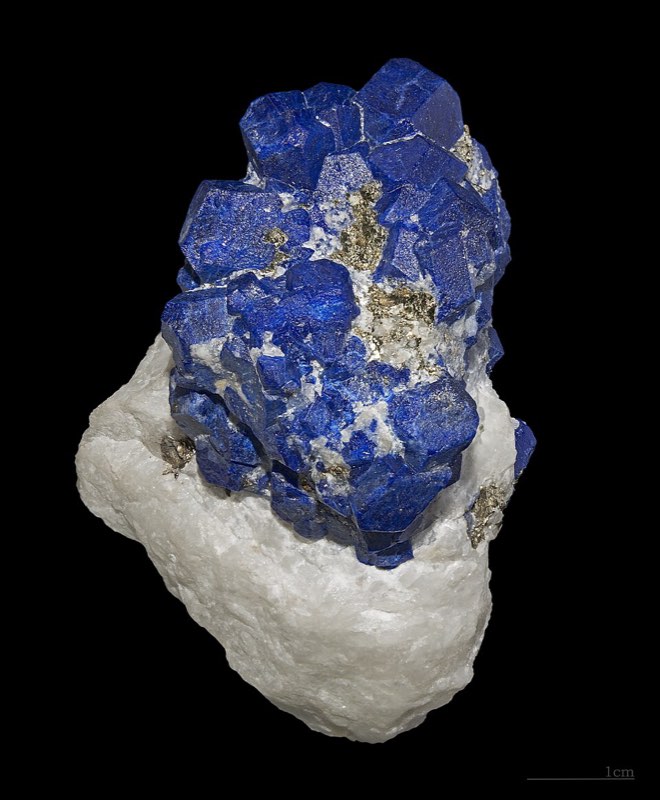
The deep blue mineral that gives lapis lazuli its color. Distinct crystals are rare.
Photo: Didier Descouens, CC BY-SA 4.0
Quick tests
- Acid (vinegar or dilute HCl): Lapis Lazuli fizzes weakly, or only when powdered or warmed; Lazurite doesn't.
- Texture: Lapis Lazuli is a rock — a mix of grains or minerals; Lazurite is a single mineral.
Key differences
- Lapis is the rock: lazurite plus calcite and pyrite.
Side by side
| Property | Lapis Lazuli | Lazurite |
|---|---|---|
| Type | Metamorphic rock | Mineral |
| Mohs hardness | 5–5.5 | 5–5.5 |
| Luster | Dull to vitreous | Dull to vitreous |
| Streak | — | Bright blue |
| Colors | Blue, Gold, White | Blue |
| Crystal system / structure | Granular, massive | Cubic |
| Specific gravity | 2.7–2.9 | 2.38–2.45 |
| Formula | — | (Na,Ca)₈(AlSiO₄)₆(SO₄,S,Cl)₂ |
| Found in | Sar-e-Sang, Afghanistan; Coquimbo, Chile | Sar-e-Sang, Afghanistan; Lake Baikal, Russia |
Properties that are the same for both are grayed out.
How to identify lapis lazuli
- Intense ultramarine blue.
- Glittering gold pyrite flecks.
- White patches of calcite.
- Light blue streak.
Structure: Granular, massive
Full Lapis Lazuli guide →How to identify lazurite
- Intense ultramarine blue.
- Usually massive grains in white marble.
- Bright blue streak.
Crystal system: Cubic
Full Lazurite guide →More comparisons
Could you tell them apart from a blurry close-up?
Play today's Rocksday