 Rocksday
Haüyne vs Lazurite
How to tell them apart
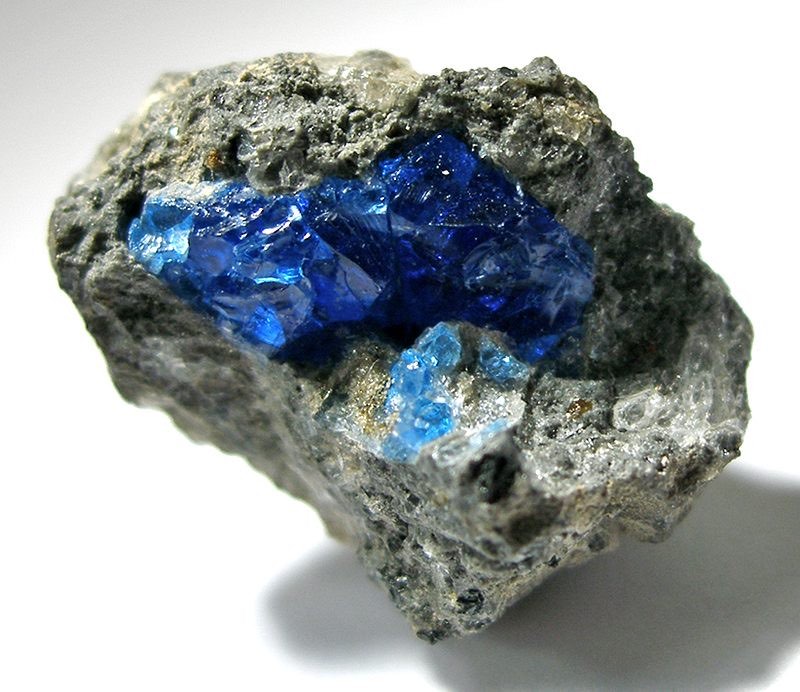
Brilliant blue grains found in some volcanic rocks — among the most vivid blues in nature.
Photo: Robert M. Lavinsky, CC BY-SA 3.0
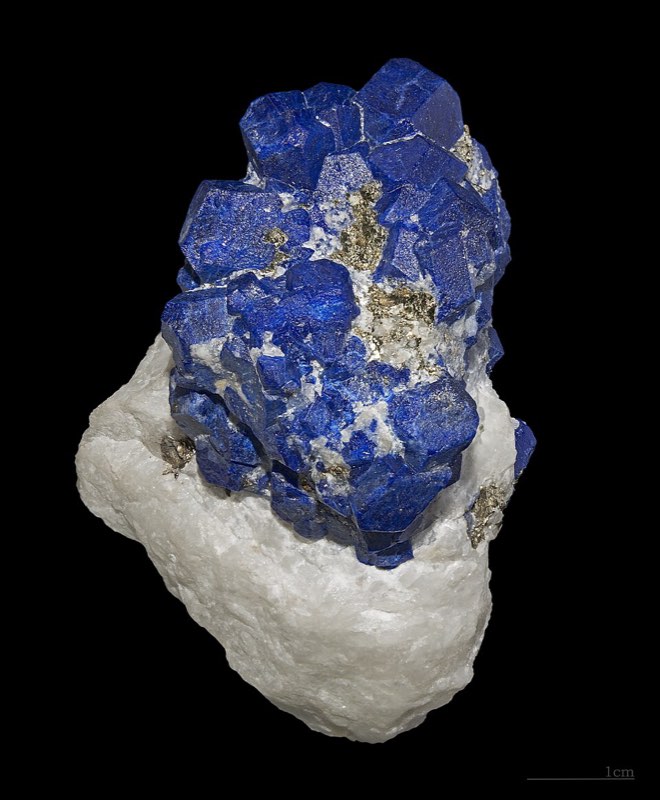
The deep blue mineral that gives lapis lazuli its color. Distinct crystals are rare.
Photo: Didier Descouens, CC BY-SA 4.0
Quick tests
- Streak (rub on unglazed porcelain): Haüyne leaves a pale blue streak; Lazurite leaves bright blue.
Key differences
- Lazurite is massive, in marble, and less transparent.
Side by side
| Property | Haüyne | Lazurite |
|---|---|---|
| Type | Mineral | Mineral |
| Mohs hardness | 5.5–6 | 5–5.5 |
| Luster | Vitreous | Dull to vitreous |
| Streak | Pale blue | Bright blue |
| Colors | Blue | Blue |
| Crystal system | Cubic | Cubic |
| Specific gravity | 2.44–2.5 | 2.38–2.45 |
| Formula | (Na,Ca)₄₋₈Al₆Si₆(O,S)₂₄(SO₄,Cl)₁₋₂ | (Na,Ca)₈(AlSiO₄)₆(SO₄,S,Cl)₂ |
| Found in | Eifel, Germany; Monte Vulture, Italy | Sar-e-Sang, Afghanistan; Lake Baikal, Russia |
Properties that are the same for both are grayed out.
How to identify haüyne
- Tiny electric-blue grains in volcanic rock.
- Rarely larger than a few millimeters.
- Hardness about 6.
Crystal system: Cubic
Full Haüyne guide →How to identify lazurite
- Intense ultramarine blue.
- Usually massive grains in white marble.
- Bright blue streak.
Crystal system: Cubic
Full Lazurite guide →More comparisons
Could you tell them apart from a blurry close-up?
Play today's Rocksday