 Rocksday
Azurite vs Lapis Lazuli
How to tell them apart
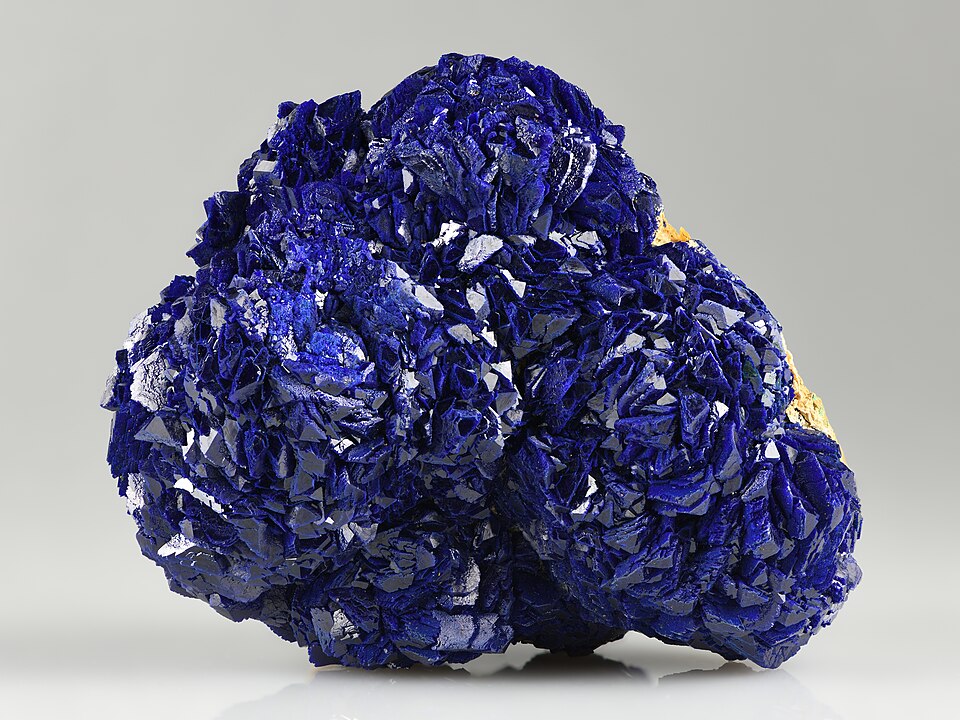
An intensely deep blue copper carbonate. Over time it slowly converts to green malachite, and the two are often found together.
Photo: Ivar Leidus, CC BY-SA 4.0
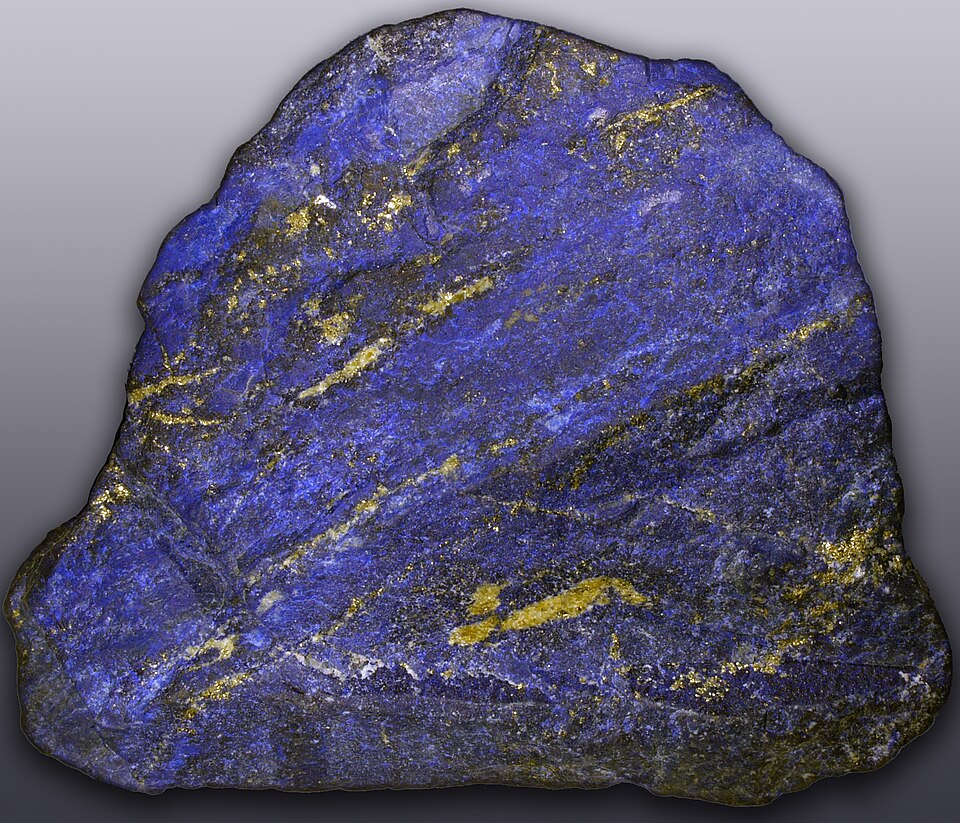
A deep-blue rock made mostly of the mineral lazurite, flecked with golden pyrite and white calcite.
Photo: Hannes Grobe, CC BY-SA 2.5
Quick tests
- Hardness: Lapis Lazuli is clearly harder: Mohs 5–5.5 versus 3.5–4.
- Acid (vinegar or dilute HCl): Azurite fizzes; Lapis Lazuli doesn't.
- Heft: Azurite feels noticeably heavier for its size (specific gravity 3.77–3.78 vs 2.7–2.9).
- Texture: Lapis Lazuli is a rock — a mix of grains or minerals; Azurite is a single mineral.
Key differences
- Lapis has gold pyrite flecks, white calcite and doesn't fizz much.
- Azurite is softer and fizzes vigorously.
Side by side
| Property | Azurite | Lapis Lazuli |
|---|---|---|
| Type | Mineral | Metamorphic rock |
| Mohs hardness | 3.5–4 | 5–5.5 |
| Luster | Vitreous | Dull to vitreous |
| Streak | Light blue | — |
| Colors | Blue | Blue, Gold, White |
| Crystal system / structure | Monoclinic | Granular, massive |
| Specific gravity | 3.77–3.78 | 2.7–2.9 |
| Formula | Cu₃(CO₃)₂(OH)₂ | — |
| Found in | Bisbee, Arizona; Tsumeb, Namibia | Sar-e-Sang, Afghanistan; Coquimbo, Chile |
Properties that are the same for both are grayed out.
How to identify azurite
- Deep 'azure' blue, often with green malachite.
- Fizzes in acid.
- Soft — a knife scratches it.
- Light blue streak.
Crystal system: Monoclinic
Full Azurite guide →How to identify lapis lazuli
- Intense ultramarine blue.
- Glittering gold pyrite flecks.
- White patches of calcite.
- Light blue streak.
Structure: Granular, massive
Full Lapis Lazuli guide →More comparisons
Could you tell them apart from a blurry close-up?
Play today's Rocksday