 Rocksday
Azurite vs Sodalite
How to tell them apart
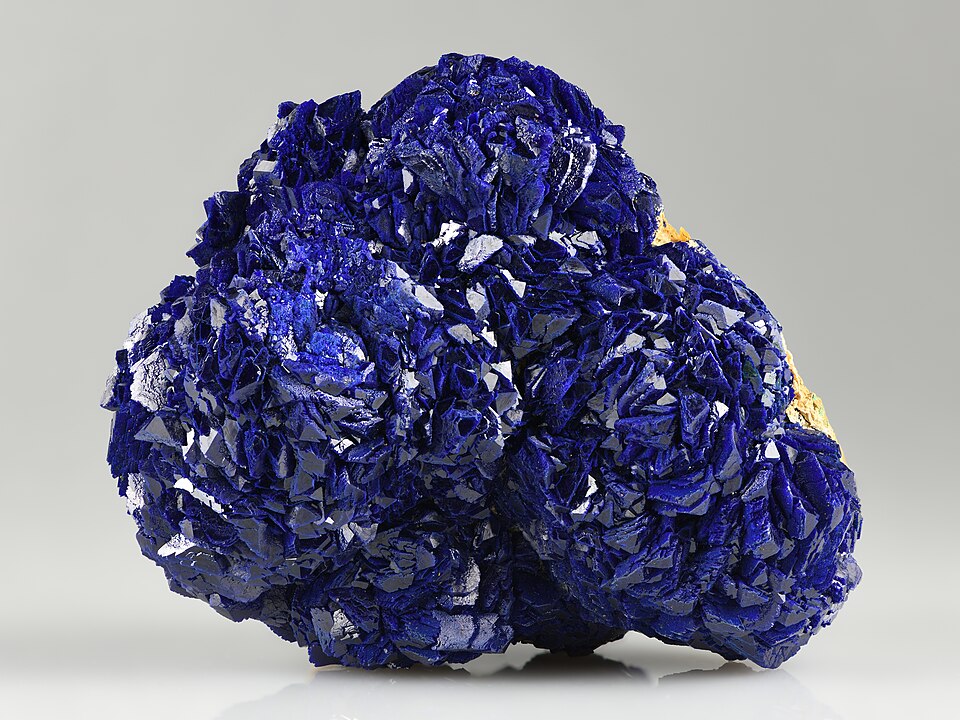
An intensely deep blue copper carbonate. Over time it slowly converts to green malachite, and the two are often found together.
Photo: Ivar Leidus, CC BY-SA 4.0
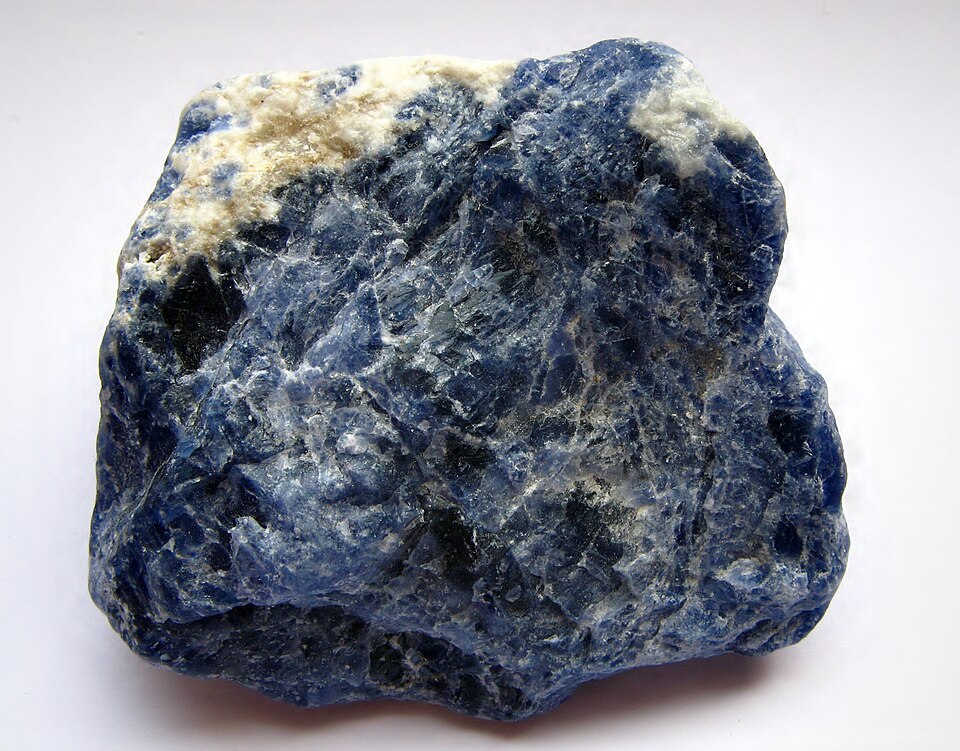
A royal-blue feldspathoid mineral, usually massive with white veins, and a popular tumbled stone.
Photo: Ra'ike (see also: de:Benutzer:Ra'ike), CC BY-SA 3.0
Quick tests
- Hardness: Sodalite is clearly harder: Mohs 5.5–6 versus 3.5–4.
- Acid (vinegar or dilute HCl): Azurite fizzes; Sodalite doesn't.
- Streak (rub on unglazed porcelain): Azurite leaves a light blue streak; Sodalite leaves white.
- Heft: Azurite feels noticeably heavier for its size (specific gravity 3.77–3.78 vs 2.27–2.33).
Key differences
- Sodalite is harder, has white veins and doesn't fizz.
- Azurite is softer and fizzes in acid.
Side by side
| Property | Azurite | Sodalite |
|---|---|---|
| Type | Mineral | Mineral |
| Mohs hardness | 3.5–4 | 5.5–6 |
| Luster | Vitreous | Vitreous to greasy |
| Streak | Light blue | White |
| Colors | Blue | Blue, White |
| Crystal system | Monoclinic | Cubic |
| Specific gravity | 3.77–3.78 | 2.27–2.33 |
| Formula | Cu₃(CO₃)₂(OH)₂ | Na₈(Al₆Si₆O₂₄)Cl₂ |
| Found in | Bisbee, Arizona; Tsumeb, Namibia | Bancroft, Ontario; Bahia, Brazil |
Properties that are the same for both are grayed out.
How to identify azurite
- Deep 'azure' blue, often with green malachite.
- Fizzes in acid.
- Soft — a knife scratches it.
- Light blue streak.
Crystal system: Monoclinic
Full Azurite guide →How to identify sodalite
- Royal blue with white veins or patches.
- Glows orange under longwave UV light.
- Hardness about 6.
- Light for a blue stone.
Crystal system: Cubic
Full Sodalite guide →More comparisons
Could you tell them apart from a blurry close-up?
Play today's Rocksday