 Rocksday
Dumortierite vs Sodalite
How to tell them apart
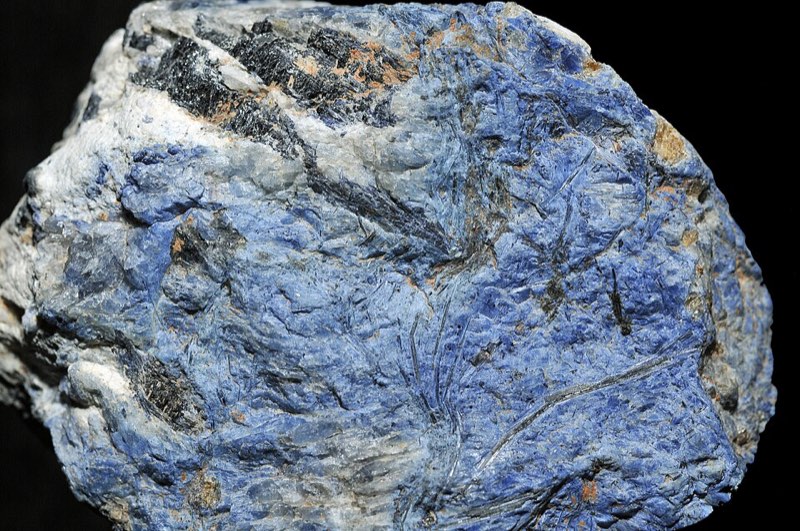
A denim-blue aluminum borosilicate, usually as fibrous masses or embedded in quartz.
Photo: Géry PARENT, CC BY-SA 3.0
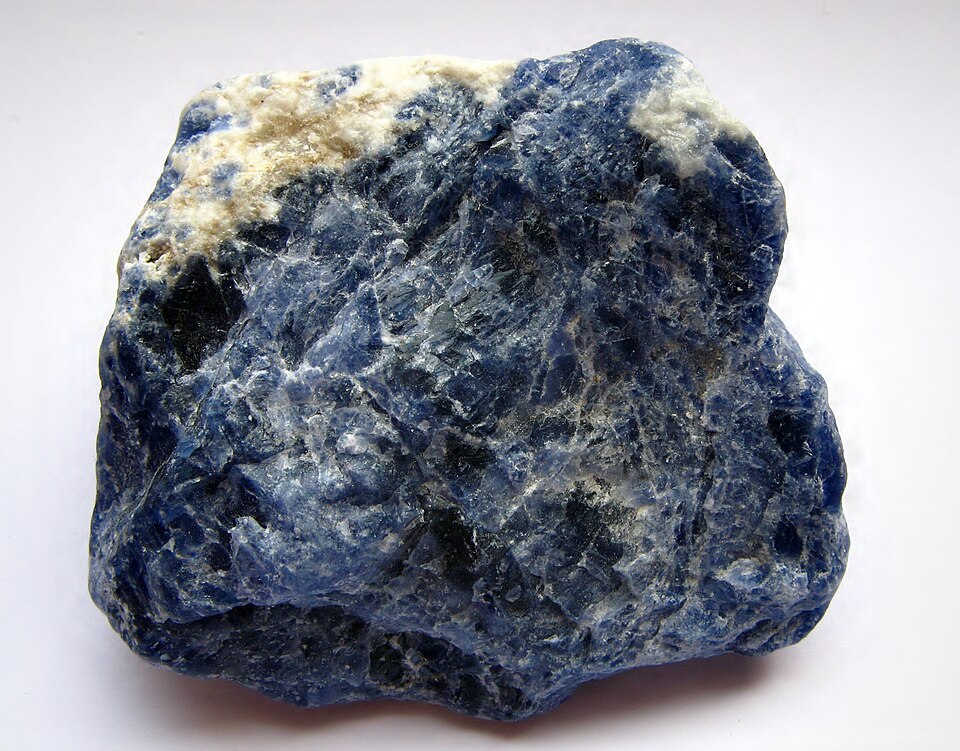
A royal-blue feldspathoid mineral, usually massive with white veins, and a popular tumbled stone.
Photo: Ra'ike (see also: de:Benutzer:Ra'ike), CC BY-SA 3.0
Quick tests
- Hardness: Dumortierite is clearly harder: Mohs 7–8.5 versus 5.5–6.
- Heft: Dumortierite feels noticeably heavier for its size (specific gravity 3.3–3.4 vs 2.27–2.33).
Key differences
- Sodalite is softer and veined with white.
Side by side
| Property | Dumortierite | Sodalite |
|---|---|---|
| Type | Mineral | Mineral |
| Mohs hardness | 7–8.5 | 5.5–6 |
| Luster | Vitreous to dull | Vitreous to greasy |
| Streak | White | White |
| Colors | Blue, Purple | Blue, White |
| Crystal system | Orthorhombic | Cubic |
| Specific gravity | 3.3–3.4 | 2.27–2.33 |
| Formula | Al₇BO₃(SiO₄)₃O₃ | Na₈(Al₆Si₆O₂₄)Cl₂ |
| Found in | Madagascar; Brazil | Bancroft, Ontario; Bahia, Brazil |
Properties that are the same for both are grayed out.
How to identify dumortierite
- Denim blue to violet, opaque and fibrous.
- Very hard and tough.
- Often speckled through quartz.
Crystal system: Orthorhombic
Full Dumortierite guide →How to identify sodalite
- Royal blue with white veins or patches.
- Glows orange under longwave UV light.
- Hardness about 6.
- Light for a blue stone.
Crystal system: Cubic
Full Sodalite guide →More comparisons
Could you tell them apart from a blurry close-up?
Play today's Rocksday