 Rocksday
Fluorite vs Halite
How to tell them apart
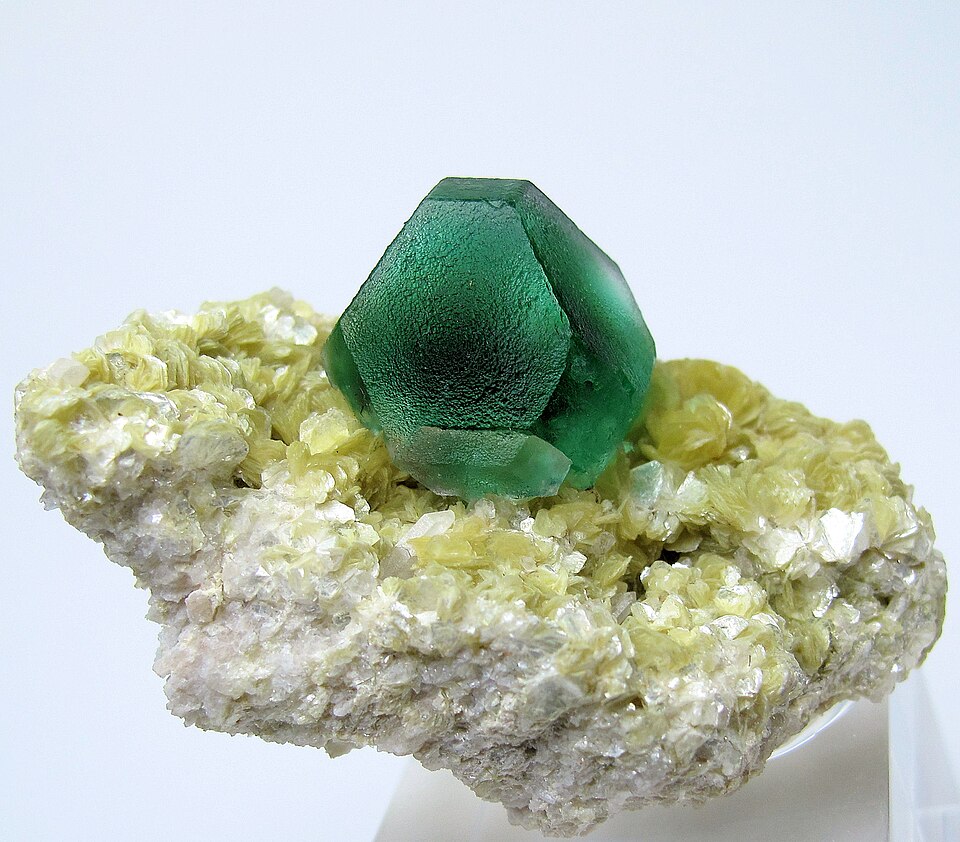
A colorful mineral that grows as cubes and splits into octahedrons. Many specimens glow under ultraviolet light — the word 'fluorescence' was coined from it.
Photo: CarlesMillan, CC BY-SA 3.0
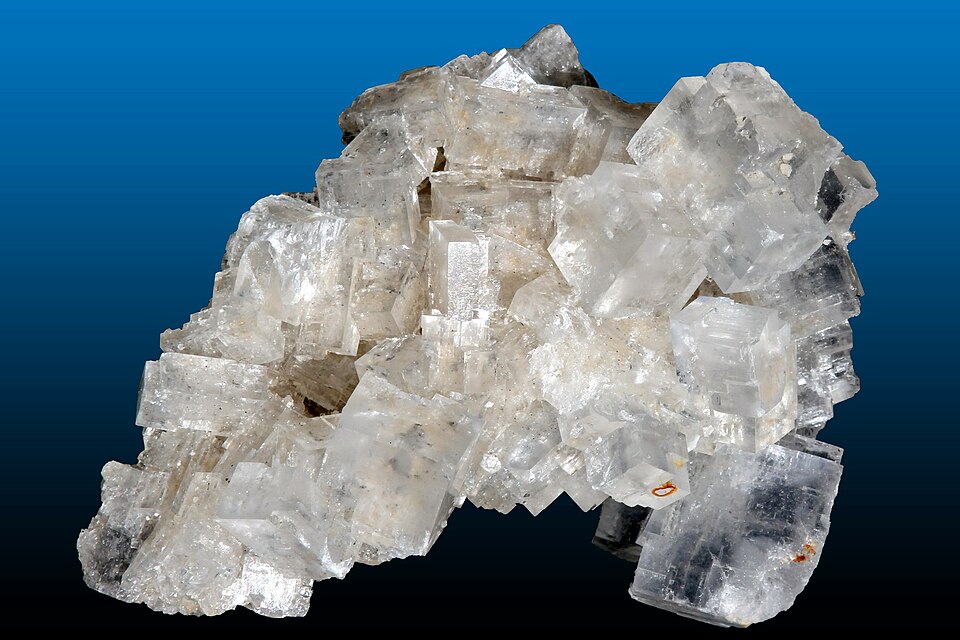
Natural table salt. It forms thick beds where ancient seas dried up and grows as cubes, sometimes with stair-stepped 'hopper' faces.
Photo: Lech Darski, CC BY-SA 4.0
Quick tests
- Fingernail: A fingernail scratches Halite (Mohs 2–2.5) but not Fluorite (Mohs 4).
- Heft: Fluorite feels noticeably heavier for its size (specific gravity 3.18 vs 2.17).
Key differences
- Fluorite is harder, doesn't dissolve and cleaves into octahedrons.
Side by side
| Property | Fluorite | Halite |
|---|---|---|
| Type | Mineral | Mineral |
| Mohs hardness | 4 | 2–2.5 |
| Luster | Vitreous | Vitreous |
| Streak | White | White |
| Colors | Purple, Green, Blue, Yellow, Clear | Clear, White, Pink, Orange |
| Crystal system | Cubic | Cubic |
| Specific gravity | 3.18 | 2.17 |
| Formula | CaF₂ | NaCl |
| Found in | Cave-in-Rock, Illinois; Weardale, England | Wieliczka, Poland; Khewra, Pakistan |
Properties that are the same for both are grayed out.
How to identify fluorite
- Cubic crystals, often with color zoning in purple and green.
- Cleaves into eight-sided octahedral fragments.
- Hardness 4 — a knife scratches it, but a coin doesn't.
- Often glows blue or violet under a UV flashlight.
Crystal system: Cubic
Full Fluorite guide →How to identify halite
- Tastes salty.
- Breaks into cubes.
- Dissolves in water.
- Soft — a fingernail almost scratches it.
Crystal system: Cubic
Full Halite guide →More comparisons
Could you tell them apart from a blurry close-up?
Play today's Rocksday