 Rocksday
Borax vs Halite
How to tell them apart
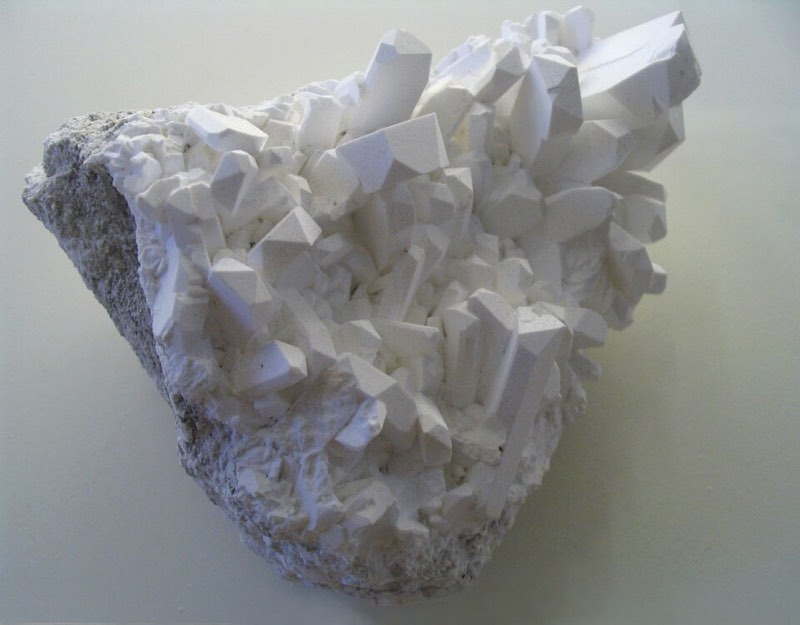
A sodium borate from dry lake beds. Clear crystals dry out to white powder in normal air.
Photo: Aram Dulyan (User:Aramgutang), Public domain
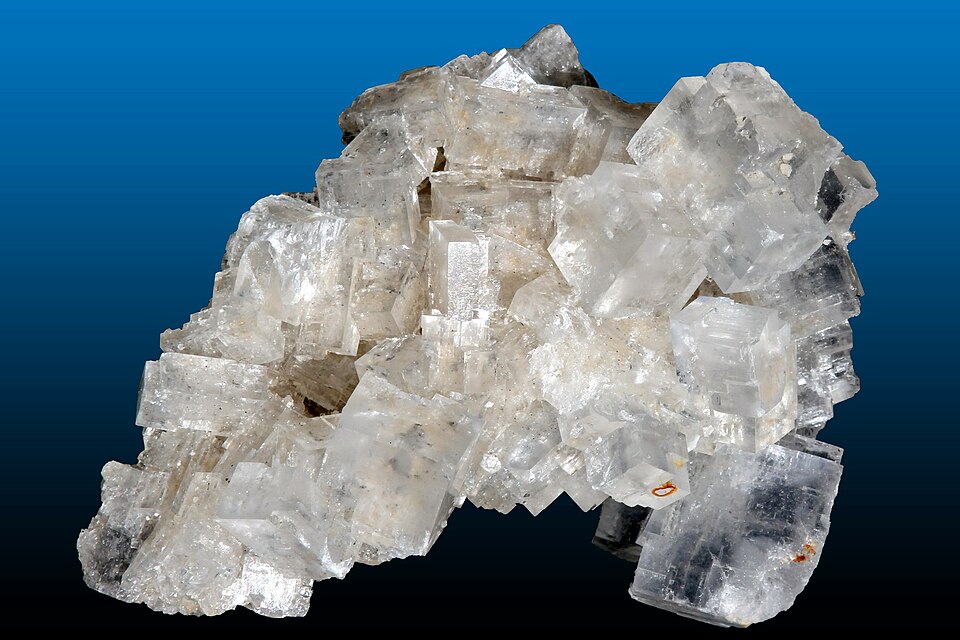
Natural table salt. It forms thick beds where ancient seas dried up and grows as cubes, sometimes with stair-stepped 'hopper' faces.
Photo: Lech Darski, CC BY-SA 4.0
Key differences
- Halite tastes salty and forms cubes.
Side by side
| Property | Borax | Halite |
|---|---|---|
| Type | Mineral | Mineral |
| Mohs hardness | 2–2.5 | 2–2.5 |
| Luster | Vitreous to dull | Vitreous |
| Streak | White | White |
| Colors | White, Clear | Clear, White, Pink, Orange |
| Crystal system | Monoclinic | Cubic |
| Specific gravity | 1.7 | 2.17 |
| Formula | Na₂B₄O₇·10H₂O | NaCl |
| Found in | Boron, California; Searles Lake, California | Wieliczka, Poland; Khewra, Pakistan |
Properties that are the same for both are grayed out.
How to identify borax
- Clear prisms that turn chalky white over time.
- Light and soft.
- Dissolves in water; sweetish-alkaline taste.
Crystal system: Monoclinic
Full Borax guide →How to identify halite
- Tastes salty.
- Breaks into cubes.
- Dissolves in water.
- Soft — a fingernail almost scratches it.
Crystal system: Cubic
Full Halite guide →More comparisons
Could you tell them apart from a blurry close-up?
Play today's Rocksday