 Rocksday
Orbicular Granite vs Rapakivi
To tell Orbicular Granite from Rapakivi: Rapakivi ovoids have one plagioclase rim, not many shells.
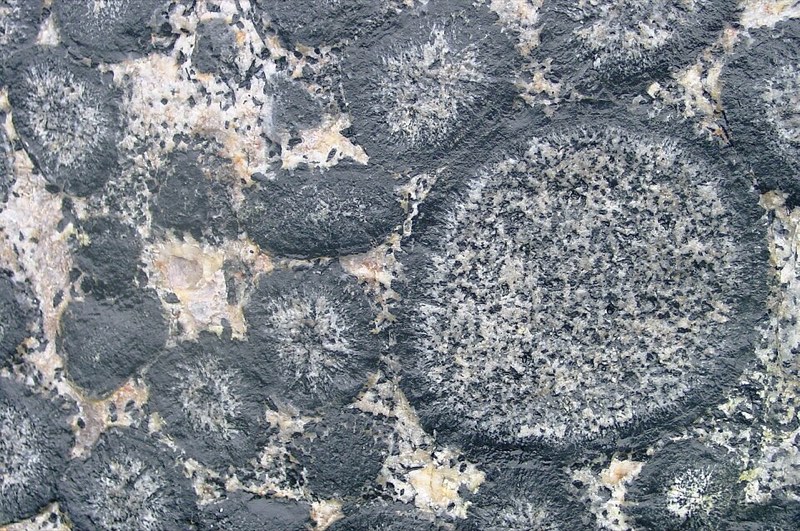
Granite full of round, layered orbs of feldspar and darker minerals that grew outward from a core.
Photo: Bachelot Pierre J-P, CC BY-SA 3.0
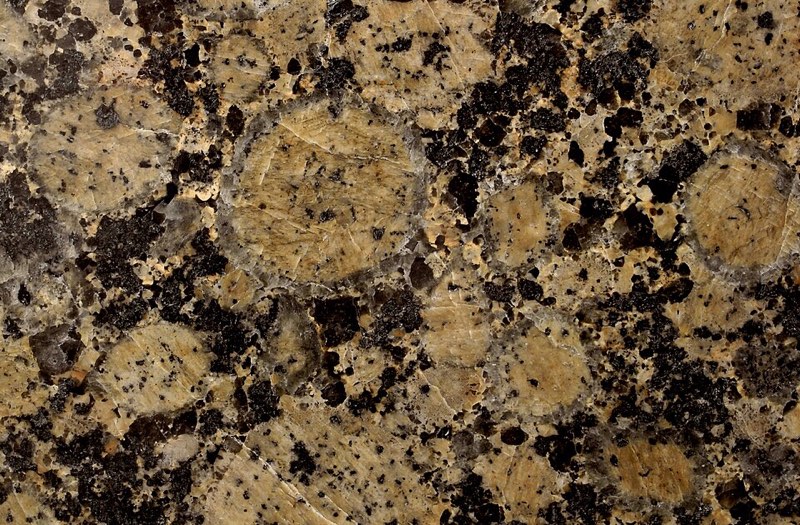
Granite with egg-shaped alkali feldspar crystals, each wrapped in a rim of plagioclase.
Photo: Lysippos, CC BY-SA 3.0
Key differences
- Rapakivi ovoids have one plagioclase rim, not many shells.
- Orbicular granite has many concentric shells, not a single plagioclase rim.
Side by side
| Property | Orbicular Granite | Rapakivi |
|---|---|---|
| Type | Igneous rock | Igneous rock |
| Mohs hardness | 6–7 | 6–7 |
| Luster | Granular | Granular |
| Colors | Gray, White, Black, Pink | Pink, Gray, Brown |
| Crystal system / structure | Concentric orbicules in granite | Ovoid feldspar with plagioclase rims |
| Specific gravity | 2.6–2.8 | 2.6–2.8 |
| Found in | Finland; Boogardie, Western Australia | Southern Finland; St. Francois Mountains, Missouri |
Properties that are the same for both are grayed out.
How to identify orbicular granite
- Spherical orbicules with concentric light and dark rings.
- The matrix between orbs is ordinary granite.
- Hard, like granite.
Structure: Concentric orbicules in granite
Full Orbicular Granite guide →How to identify rapakivi
- Round pink or brown feldspar ovoids.
- A pale rim around many of the ovoids.
- Coarse, with quartz and dark mica or hornblende.
Structure: Ovoid feldspar with plagioclase rims
Full Rapakivi guide →More comparisons
Frequently asked questions
What is the difference between orbicular granite and rapakivi?
Orbicular Granite is an igneous rock with a Mohs hardness of about 6–7 and a granular luster, usually gray, white, black or pink. Rapakivi is an igneous rock with a Mohs hardness of about 6–7 and a granular luster, usually pink, gray or brown.
How can you tell orbicular granite from rapakivi?
Rapakivi ovoids have one plagioclase rim, not many shells. Orbicular granite has many concentric shells, not a single plagioclase rim.
Could you tell them apart from a blurry close-up?
Play today's Rocksday