 Rocksday
Hematite vs Magnetite
How to tell them apart
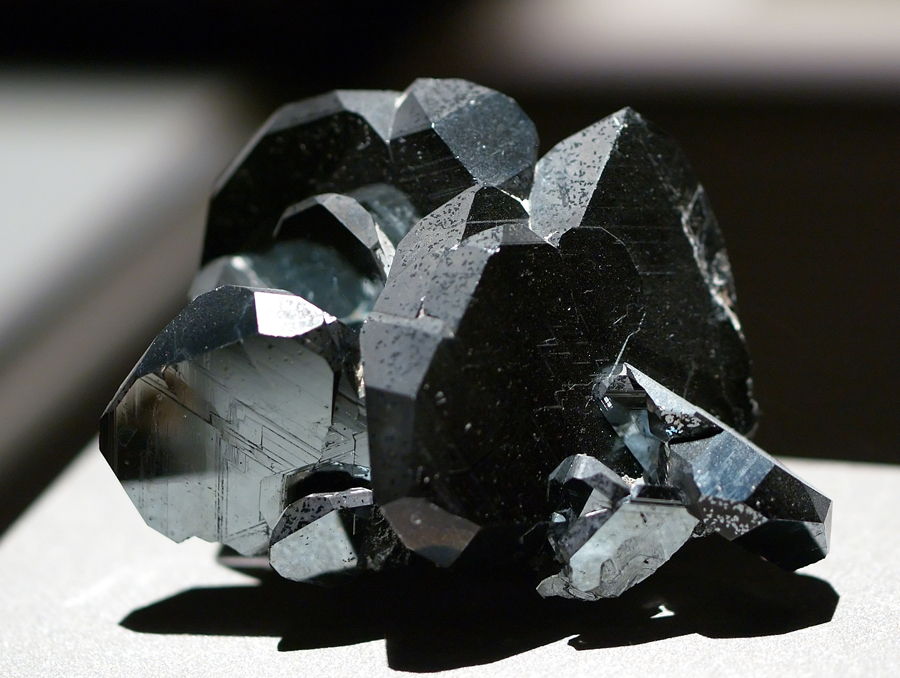
Iron oxide and the world's most important iron ore. It can be shiny steel-gray or earthy red, but always leaves a reddish streak.
Photo: Wikipedia Loves Art participant "Assignment_Houston_One", CC BY-SA 2.5
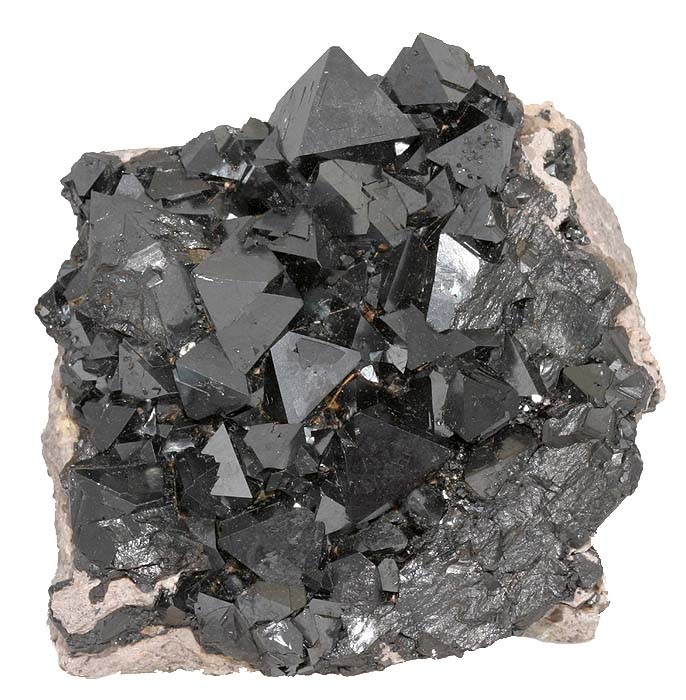
The most magnetic naturally occurring mineral. Black, heavy and often found as eight-sided crystals or as black sand on beaches.
Photo: Robert M. Lavinsky, CC BY-SA 3.0
Quick tests
- Magnet: A magnet sticks to Magnetite but not to Hematite.
- Streak (rub on unglazed porcelain): Hematite leaves a reddish brown streak; Magnetite leaves black.
Key differences
- Magnetite leaves a black streak and grabs a magnet.
- Hematite has a red-brown streak and is weak or not magnetic.
Side by side
| Property | Hematite | Magnetite |
|---|---|---|
| Type | Mineral | Mineral |
| Mohs hardness | 5.5–6.5 | 5.5–6.5 |
| Luster | Metallic to earthy | Metallic |
| Streak | Reddish brown | Black |
| Colors | Silver, Black, Red | Black |
| Crystal system | Trigonal | Cubic |
| Specific gravity | 5.26 | 5.1–5.2 |
| Formula | Fe₂O₃ | Fe₃O₄ |
| Found in | Lake Superior iron ranges; Carajás, Brazil | Kiruna, Sweden; Adirondack Mountains, New York |
Properties that are the same for both are grayed out.
How to identify hematite
- Reddish-brown streak — the key test, even on silvery pieces.
- Heavy for its size.
- Not magnetic (or only weakly).
- Sometimes forms bubbly 'kidney ore' masses.
Crystal system: Trigonal
Full Hematite guide →How to identify magnetite
- Strongly attracts a magnet (some pieces are magnets themselves).
- Black streak.
- Heavy, black, metallic.
- Octahedral crystals when well-formed.
Crystal system: Cubic
Full Magnetite guide →More comparisons
Could you tell them apart from a blurry close-up?
Play today's Rocksday