 Rocksday
Banded Iron Formation vs Hematite
How to tell them apart
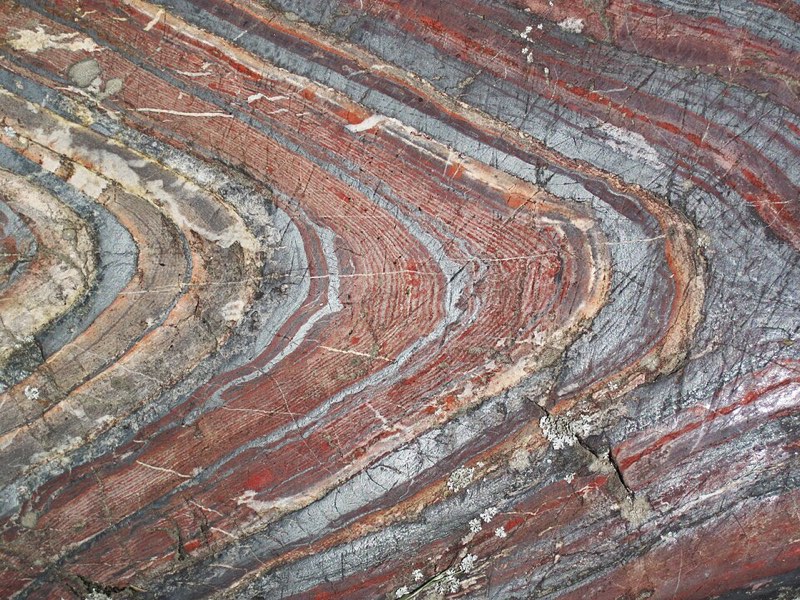
Ancient rock of alternating red chert and silvery iron oxide bands, mostly 1.8–2.5 billion years old.
Photo: James St. John, CC BY 2.0
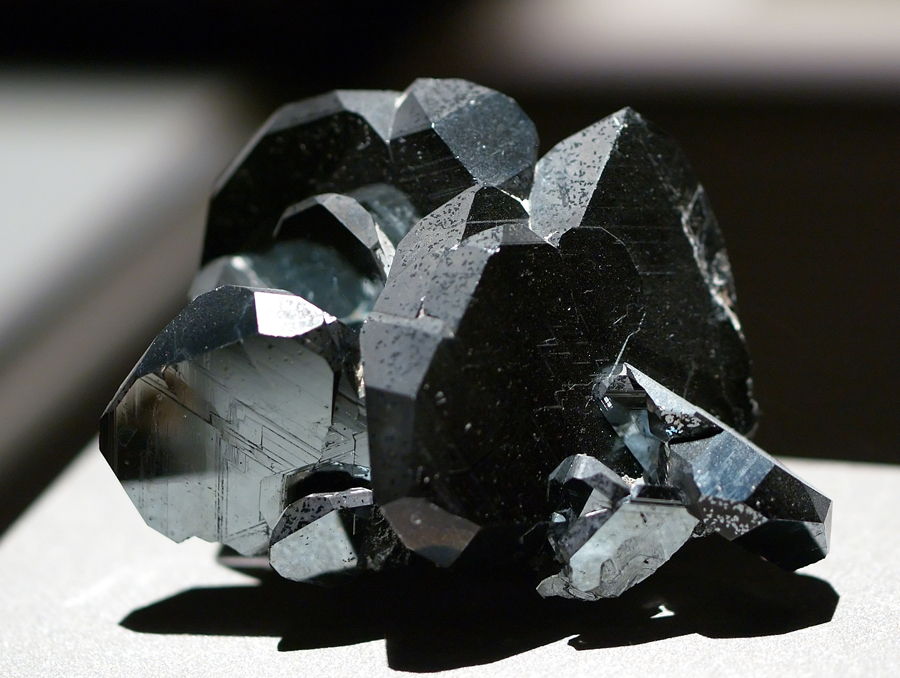
Iron oxide and the world's most important iron ore. It can be shiny steel-gray or earthy red, but always leaves a reddish streak.
Photo: Wikipedia Loves Art participant "Assignment_Houston_One", CC BY-SA 2.5
Quick tests
- Heft: Hematite feels noticeably heavier for its size (specific gravity 5.26 vs 3–3.8).
- Texture: Banded Iron Formation is a rock — a mix of grains or minerals; Hematite is a single mineral.
Key differences
- Hematite is the iron mineral; BIF is the layered rock.
Side by side
| Property | Banded Iron Formation | Hematite |
|---|---|---|
| Type | Sedimentary rock | Mineral |
| Mohs hardness | 5.5–7 | 5.5–6.5 |
| Luster | Metallic and waxy bands | Metallic to earthy |
| Streak | — | Reddish brown |
| Colors | Red, Silver, Black | Silver, Black, Red |
| Crystal system / structure | Alternating iron oxide and chert bands | Trigonal |
| Specific gravity | 3–3.8 | 5.26 |
| Formula | — | Fe₂O₃ |
| Found in | Hamersley Range, Western Australia; Mesabi Range, Minnesota | Lake Superior iron ranges; Carajás, Brazil |
Properties that are the same for both are grayed out.
How to identify banded iron formation
- Striking red and steel-gray stripes.
- Heavy.
- Silver bands leave a red-brown streak (hematite).
Structure: Alternating iron oxide and chert bands
Full Banded Iron Formation guide →How to identify hematite
- Reddish-brown streak — the key test, even on silvery pieces.
- Heavy for its size.
- Not magnetic (or only weakly).
- Sometimes forms bubbly 'kidney ore' masses.
Crystal system: Trigonal
Full Hematite guide →More comparisons
Could you tell them apart from a blurry close-up?
Play today's Rocksday