 Rocksday
Granodiorite vs Tonalite
To tell Granodiorite from Tonalite: Granodiorite has more potassium feldspar, often as pink grains.
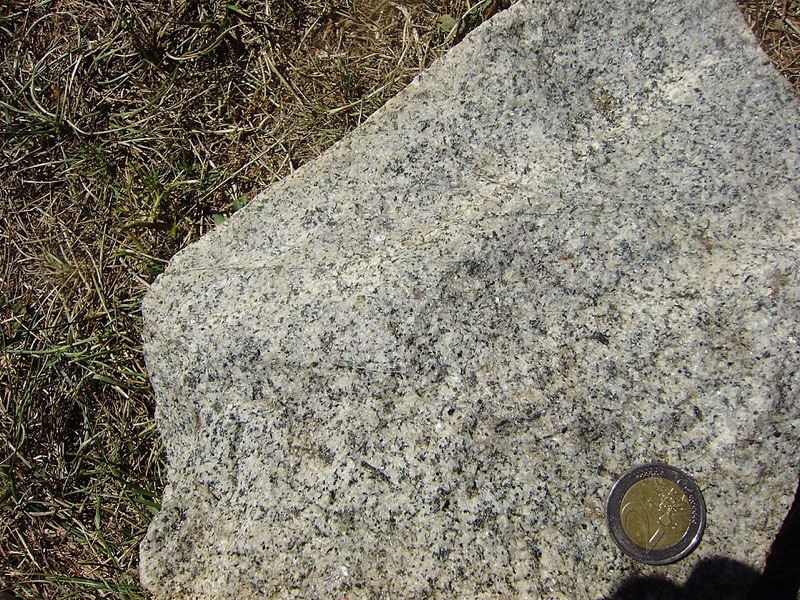
A gray, granite-like rock with more white plagioclase than granite — the most common rock of continental crust.
Photo: Rudolf Pohl, CC BY-SA 3.0
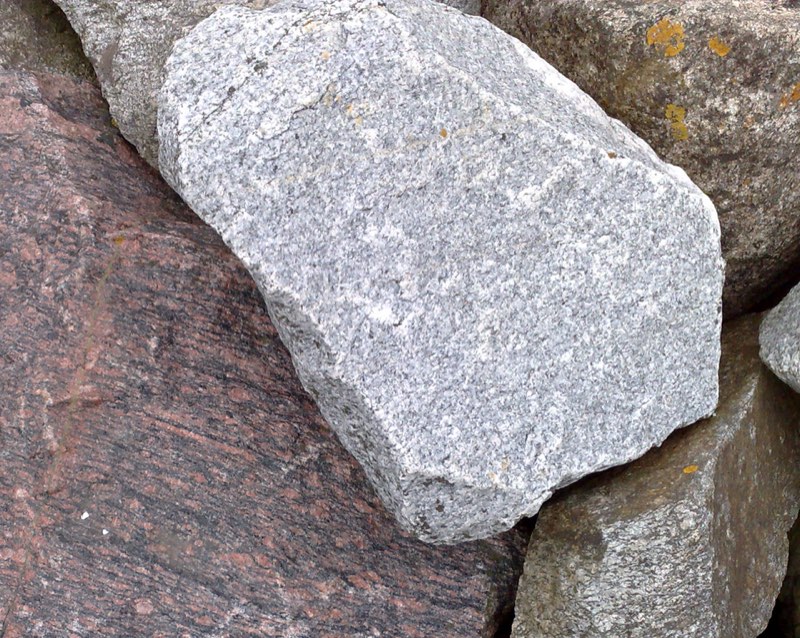
A coarse intrusive rock of quartz and plagioclase with almost no potassium feldspar. It looks like a gray granite.
Photo: Ingwik, Public domain
Key differences
- Granodiorite has more potassium feldspar, often as pink grains.
Side by side
| Property | Granodiorite | Tonalite |
|---|---|---|
| Type | Igneous rock | Igneous rock |
| Mohs hardness | 6–7 | 6–7 |
| Luster | Granular | Granular |
| Colors | Gray, White, Black | Gray, White, Black |
| Crystal system / structure | Coarse-grained (phaneritic) | Coarse-grained (phaneritic) |
| Specific gravity | 2.7–2.8 | 2.6–2.8 |
| Found in | Half Dome, Yosemite; Coast Mountains, British Columbia | Tonale Pass, Italy; Coastal Batholith, Peru |
Properties that are the same for both are grayed out.
How to identify granodiorite
- Salt-and-pepper gray with some glassy quartz.
- Mostly white plagioclase, little pink feldspar.
- Coarse, even grains.
Structure: Coarse-grained (phaneritic)
Full Granodiorite guide →How to identify tonalite
- Gray, speckled, with glassy quartz.
- Feldspar is white plagioclase, not pink alkali feldspar.
- Dark grains of hornblende or biotite.
Structure: Coarse-grained (phaneritic)
Full Tonalite guide →More comparisons
Frequently asked questions
What is the difference between granodiorite and tonalite?
Granodiorite is an igneous rock with a Mohs hardness of about 6–7 and a granular luster, usually gray, white or black. Tonalite is an igneous rock with a Mohs hardness of about 6–7 and a granular luster, usually gray, white or black.
How can you tell granodiorite from tonalite?
Granodiorite has more potassium feldspar, often as pink grains.
Could you tell them apart from a blurry close-up?
Play today's Rocksday