 Rocksday
Glossopteris vs Graptolite
To tell Glossopteris from Graptolite: Graptolites are narrow toothed films, not leaves.
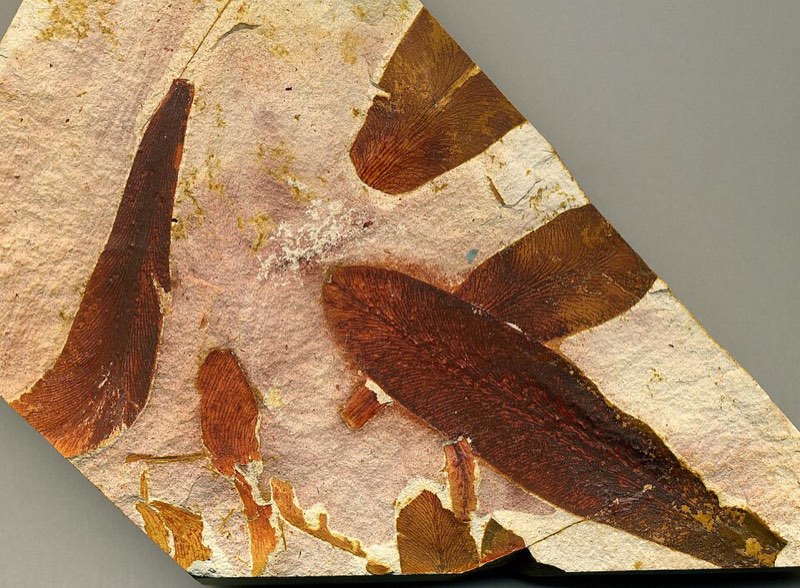
Tongue-shaped leaves of a Permian seed plant that grew across the southern continents when they were still joined.
Photo: James St. John, CC BY 2.0
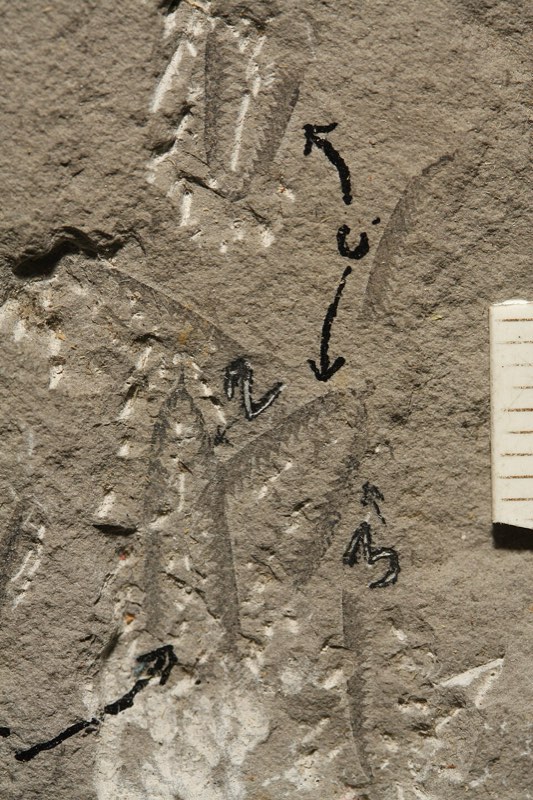
Saw-blade or twig-like carbon films on black shale, left by tiny colonial animals. They are classic index fossils.
Photo: Grezmagro, CC BY-SA 4.0
Key differences
- Graptolites are narrow toothed films, not leaves.
- Glossopteris is a leaf with a midrib, not a toothed strip.
Side by side
| Property | Glossopteris | Graptolite |
|---|---|---|
| Type | Fossil | Fossil |
| Mohs hardness | 2–4 | 2–3 |
| Luster | Dull | Dull |
| Colors | Black, Brown, Gray | Black, Gray, White |
| Crystal system / structure | Leaf impression | Carbon film on shale |
| Specific gravity | 2.4–2.7 | 2.4–2.7 |
| Found in | India; Australia | Dob's Linn, Scotland; New York |
Properties that are the same for both are grayed out.
How to identify glossopteris
- A simple tongue-shaped leaf with a strong midrib and a net of side veins.
- Usually a flat impression in shale or sandstone.
- No saw-tooth strip like a graptolite.
Structure: Leaf impression
Full Glossopteris guide →How to identify graptolite
- Dark marks like a hacksaw blade, a tuning fork or a twig on shale.
- The fossil is a film, not a raised shell.
- The host rock splits into thin slabs.
Structure: Carbon film on shale
Full Graptolite guide →More comparisons
Frequently asked questions
What is the difference between glossopteris and graptolite?
Glossopteris is a fossil with a Mohs hardness of about 2–4 and a dull luster, usually black, brown or gray. Graptolite is a fossil with a Mohs hardness of about 2–3 and a dull luster, usually black, gray or white.
How can you tell glossopteris from graptolite?
Graptolites are narrow toothed films, not leaves. Glossopteris is a leaf with a midrib, not a toothed strip.
Could you tell them apart from a blurry close-up?
Play today's Rocksday