 Rocksday
Eudialyte vs Rhodonite
To tell Eudialyte from Rhodonite: Rhodonite is usually pink with black veins and is a manganese silicate.
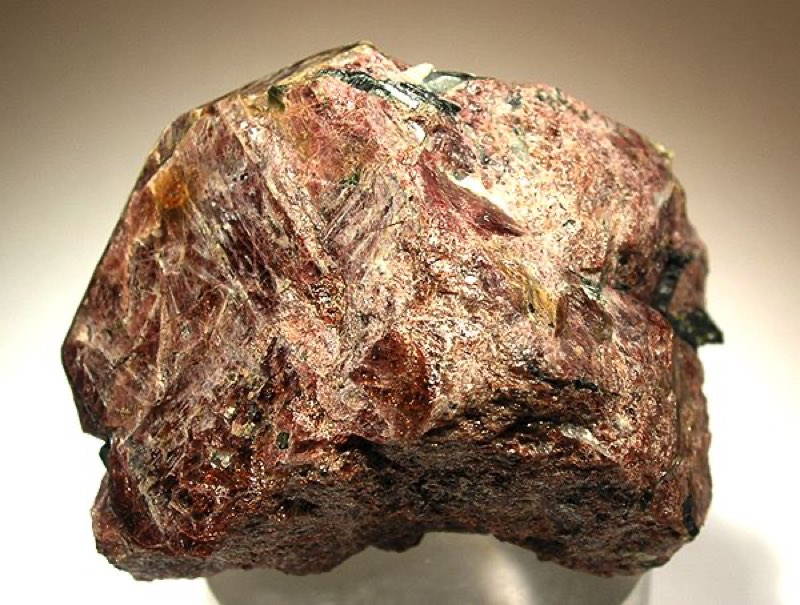
A complex sodium-zirconium silicate, usually raspberry red, from nepheline syenites.
Photo: Robert M. Lavinsky, CC BY-SA 3.0
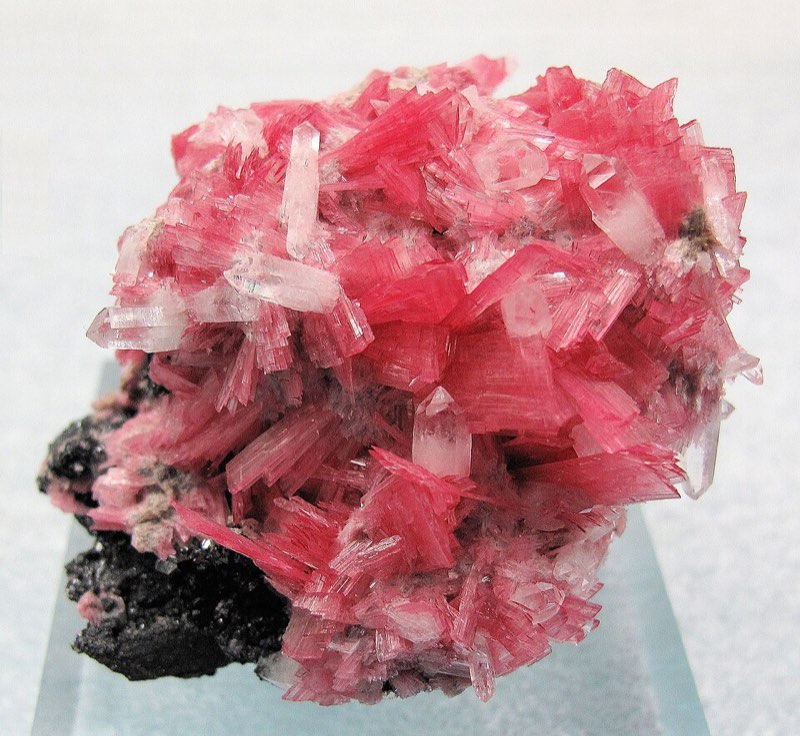
A rose-pink manganese silicate usually laced with black veins of manganese oxide.
Photo: CarlesMillan, CC BY-SA 4.0
Key differences
- Rhodonite is usually pink with black veins and is a manganese silicate.
Side by side
| Property | Eudialyte | Rhodonite |
|---|---|---|
| Type | Mineral | Mineral |
| Mohs hardness | 5–5.5 | 5.5–6.5 |
| Luster | Vitreous | Vitreous |
| Streak | White | White |
| Colors | Red, Pink, Brown | Pink, Red, Black |
| Crystal system | Trigonal | Triclinic |
| Specific gravity | 2.8–3.1 | 3.4–3.7 |
| Formula | — | (Mn,Fe,Mg,Ca)SiO₃ |
| Found in | Khibiny, Kola Peninsula, Russia; Ilímaussaq, Greenland | Ural Mountains, Russia; Broken Hill, Australia |
Properties that are the same for both are grayed out.
How to identify eudialyte
- Raspberry-red masses or blocky crystals in a pale syenite.
- Hardness about 5–5.5 — a knife scratches it.
- Not as heavy as garnet.
Crystal system: Trigonal
Full Eudialyte guide →How to identify rhodonite
- Pink to raspberry with black veins or patches.
- Hardness about 6 — scratches glass slightly.
- Does not fizz in acid.
Crystal system: Triclinic
Full Rhodonite guide →More comparisons
Frequently asked questions
What is the difference between eudialyte and rhodonite?
Eudialyte is a mineral with a Mohs hardness of 5–5.5 and a vitreous luster, usually red, pink or brown. Rhodonite is a mineral with a Mohs hardness of 5.5–6.5 and a vitreous luster, usually pink, red or black.
How can you tell eudialyte from rhodonite?
Rhodonite is usually pink with black veins and is a manganese silicate.
Could you tell them apart from a blurry close-up?
Play today's Rocksday