 Rocksday
Rhodonite vs Rose Quartz
How to tell them apart
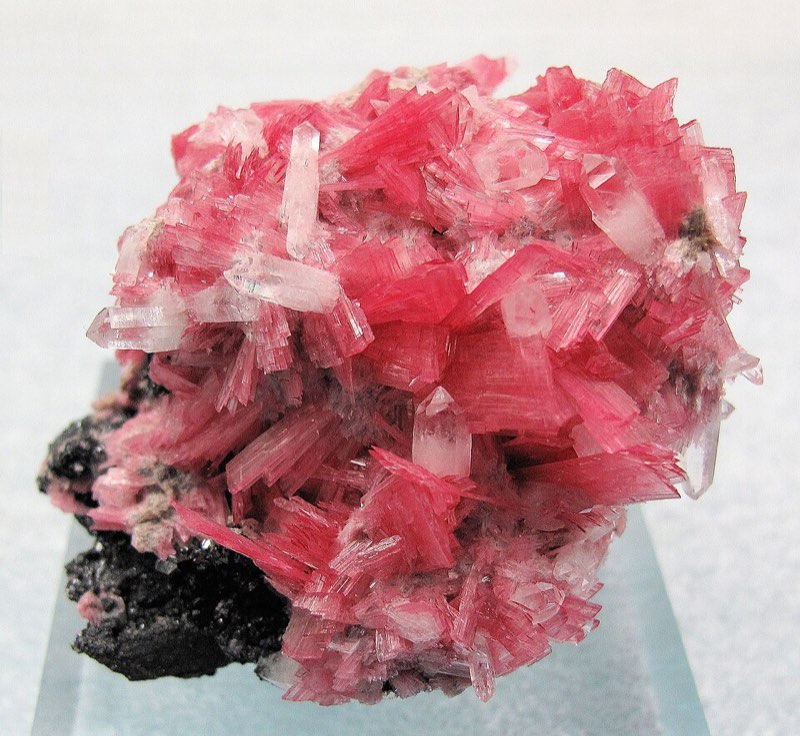
A rose-pink manganese silicate usually laced with black veins of manganese oxide.
Photo: CarlesMillan, CC BY-SA 4.0
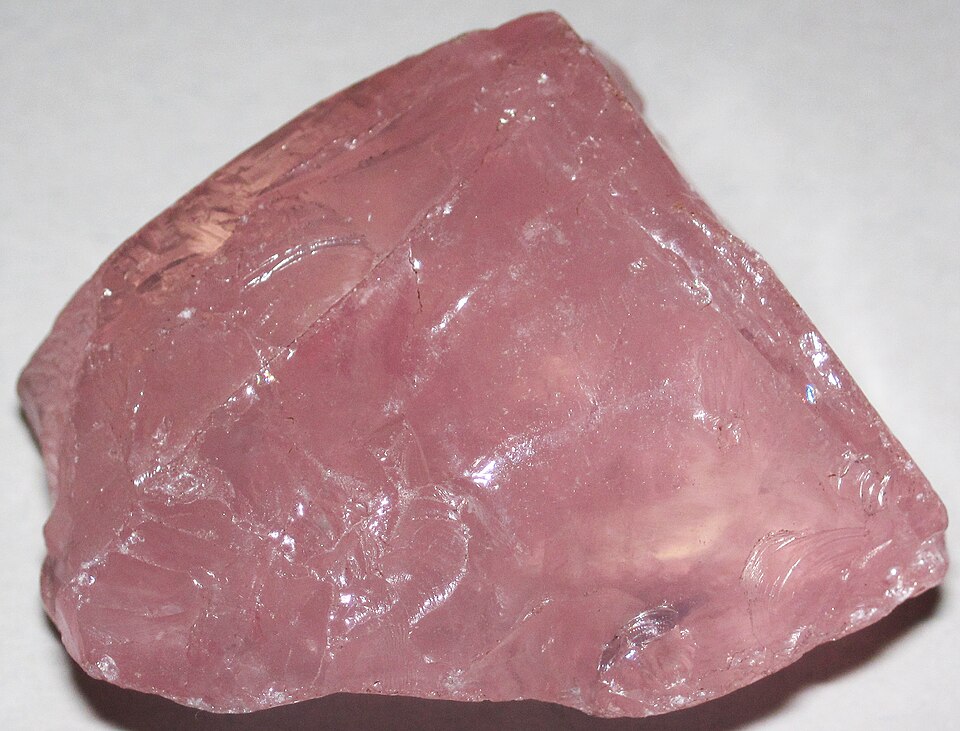
Pink, usually cloudy quartz that almost always forms as massive chunks rather than crystals. The color comes from microscopic fibrous inclusions.
Photo: James St. John, CC BY 2.0
Quick tests
- Heft: Rhodonite feels noticeably heavier for its size (specific gravity 3.4–3.7 vs 2.65).
Key differences
- Rose quartz is paler and has no black veins.
Side by side
| Property | Rhodonite | Rose Quartz |
|---|---|---|
| Type | Mineral | Mineral |
| Mohs hardness | 5.5–6.5 | 7 |
| Luster | Vitreous | Vitreous to greasy |
| Streak | White | White |
| Colors | Pink, Red, Black | Pink |
| Crystal system | Triclinic | Trigonal |
| Specific gravity | 3.4–3.7 | 2.65 |
| Formula | (Mn,Fe,Mg,Ca)SiO₃ | SiO₂ |
| Found in | Ural Mountains, Russia; Broken Hill, Australia | Black Hills, South Dakota; Minas Gerais, Brazil |
Properties that are the same for both are grayed out.
How to identify rhodonite
- Pink to raspberry with black veins or patches.
- Hardness about 6 — scratches glass slightly.
- Does not fizz in acid.
Crystal system: Triclinic
Full Rhodonite guide →How to identify rose quartz
- Soft pink and translucent-to-cloudy.
- Hardness 7 — scratches glass.
- Usually massive, with no crystal faces.
- No banding.
Crystal system: Trigonal
Full Rose Quartz guide →More comparisons
Could you tell them apart from a blurry close-up?
Play today's Rocksday