 Rocksday
Rhodochrosite vs Rose Quartz
How to tell them apart
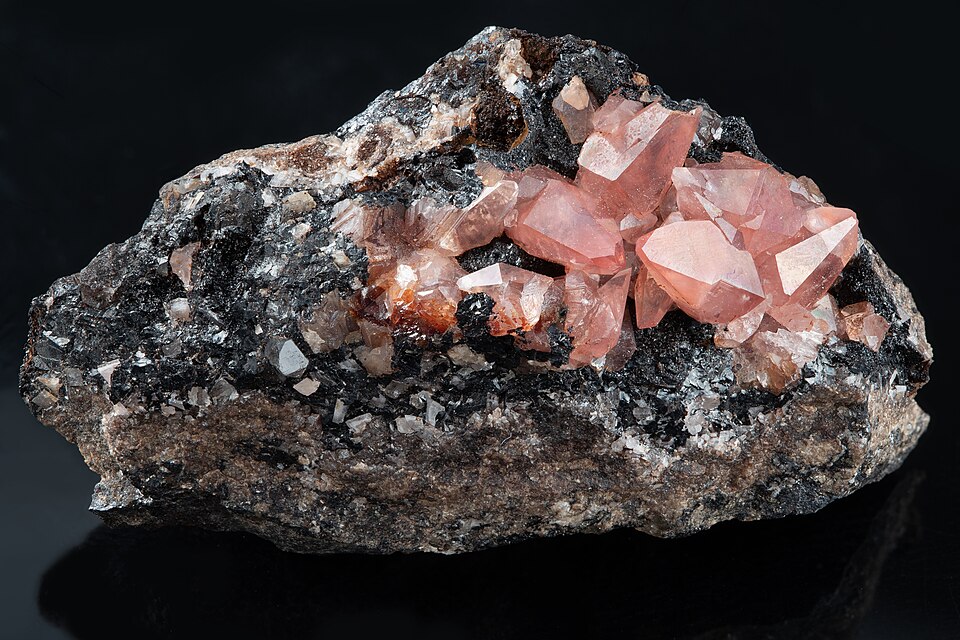
A manganese carbonate in raspberry-red crystals or rose-and-white banded stalactites.
Photo: JJ Harrison (https://www.jjharrison.com.au/), CC BY-SA 4.0
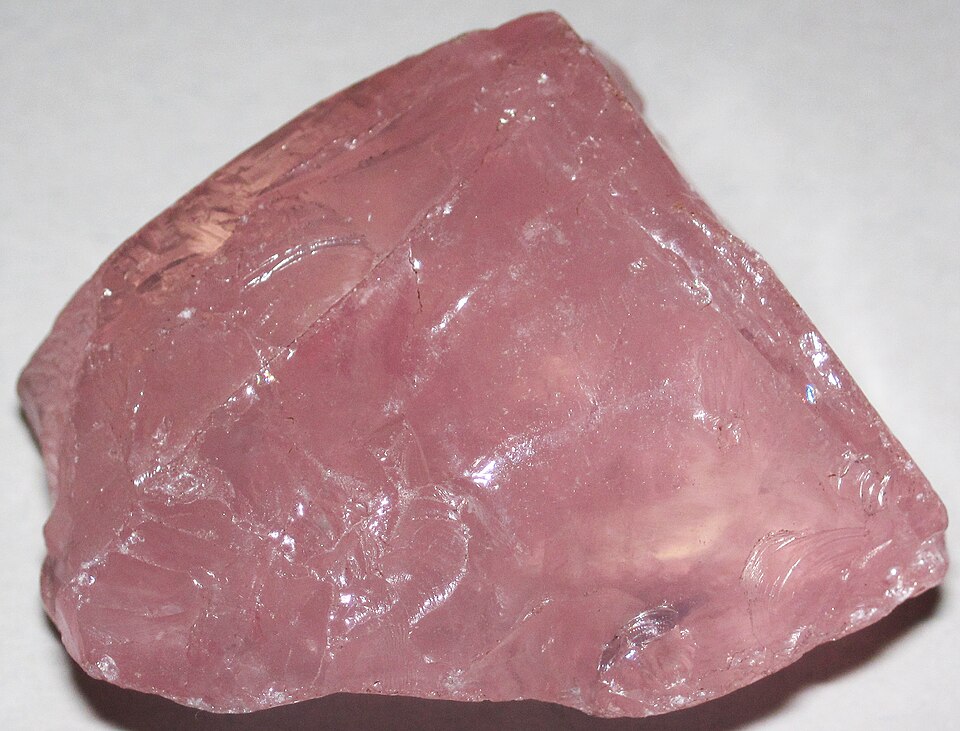
Pink, usually cloudy quartz that almost always forms as massive chunks rather than crystals. The color comes from microscopic fibrous inclusions.
Photo: James St. John, CC BY 2.0
Quick tests
- Scratch glass: Rose Quartz scratches glass (Mohs 7); Rhodochrosite can't (Mohs 3.5–4).
- Acid (vinegar or dilute HCl): Rhodochrosite fizzes weakly, or only when powdered or warmed; Rose Quartz doesn't.
- Heft: Rhodochrosite feels noticeably heavier for its size (specific gravity 3.5–3.7 vs 2.65).
Key differences
- Rose quartz is much harder and never banded.
- Rhodochrosite is softer, often banded in rose and white, and much denser.
Side by side
| Property | Rhodochrosite | Rose Quartz |
|---|---|---|
| Type | Mineral | Mineral |
| Mohs hardness | 3.5–4 | 7 |
| Luster | Vitreous | Vitreous to greasy |
| Streak | White | White |
| Colors | Pink, Red | Pink |
| Crystal system | Trigonal | Trigonal |
| Specific gravity | 3.5–3.7 | 2.65 |
| Formula | MnCO₃ | SiO₂ |
| Found in | Capillitas, Argentina; Sweet Home Mine, Colorado | Black Hills, South Dakota; Minas Gerais, Brazil |
Properties that are the same for both are grayed out.
How to identify rhodochrosite
- Rose-pink to red, often banded.
- Rhomb-shaped crystals and cleavage.
- Fizzes in warm acid.
- Soft — a knife scratches it.
Crystal system: Trigonal
Full Rhodochrosite guide →How to identify rose quartz
- Soft pink and translucent-to-cloudy.
- Hardness 7 — scratches glass.
- Usually massive, with no crystal faces.
- No banding.
Crystal system: Trigonal
Full Rose Quartz guide →More comparisons
Could you tell them apart from a blurry close-up?
Play today's Rocksday