 Rocksday
Black Tourmaline vs Elbaite
To tell Black Tourmaline from Elbaite: Schorl is opaque black and is the iron species.
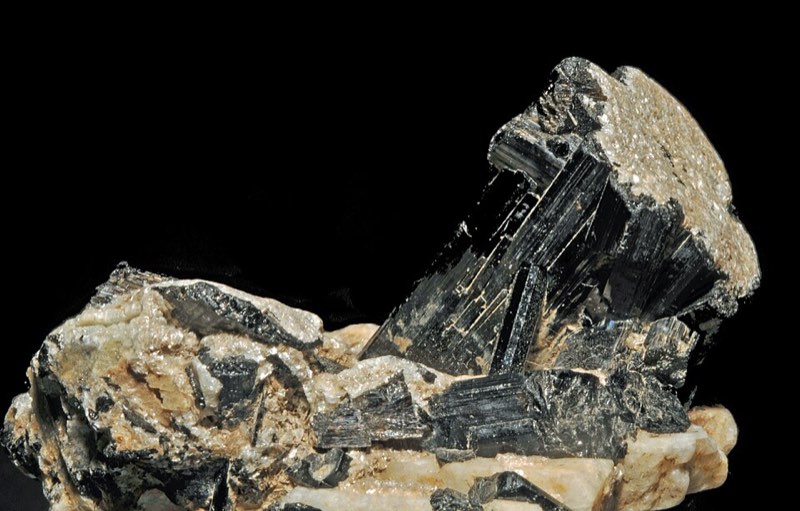
Schorl, the iron tourmaline and the most common species of the group. Opaque black prisms with a triangular cross-section.
Photo: Parent Géry, CC BY-SA 3.0
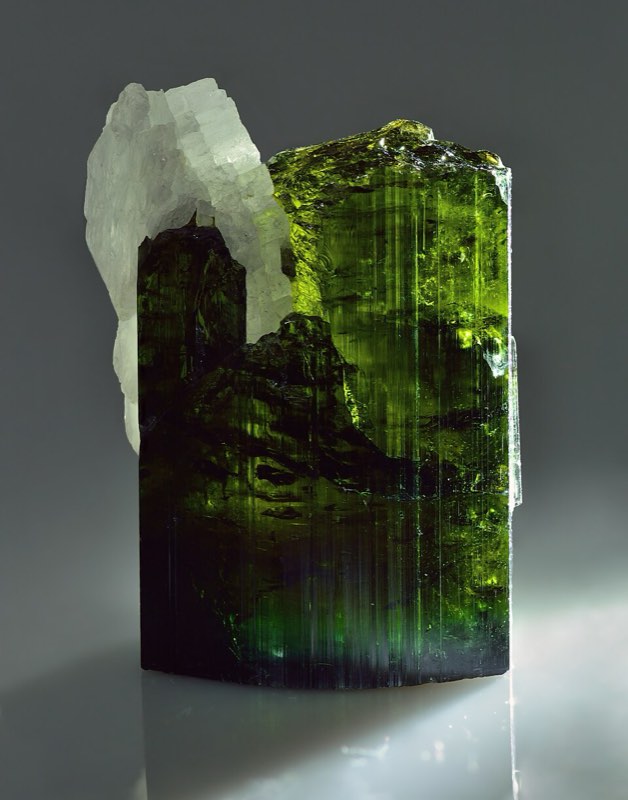
The lithium tourmaline behind most green, pink and multicolored gem tourmaline, including watermelon crystals.
Photo: Ivar Leidus, CC BY-SA 4.0
Key differences
- Schorl is opaque black and is the iron species.
Side by side
| Property | Black Tourmaline | Elbaite |
|---|---|---|
| Type | Mineral | Mineral |
| Mohs hardness | 7–7.5 | 7–7.5 |
| Luster | Vitreous | Vitreous |
| Streak | White | White |
| Colors | Black | Green, Pink, Red, Blue, Yellow |
| Crystal system | Trigonal | Trigonal |
| Specific gravity | 3.1–3.25 | 3–3.1 |
| Formula | NaFe₃Al₆(BO₃)₃Si₆O₁₈(OH)₄ | Na(Li₁.₅Al₁.₅)Al₆(BO₃)₃Si₆O₁₈(OH)₄ |
| Found in | Erongo, Namibia; Minas Gerais, Brazil | Minas Gerais, Brazil; San Diego County, California |
Properties that are the same for both are grayed out.
How to identify black tourmaline
- Black prisms with lengthwise grooves.
- A broken end is a rounded triangle, not a circle.
- Hard — scratches glass. White streak, not black.
- No cleavage. A magnet does not stick.
Crystal system: Trigonal
Full Black Tourmaline guide →How to identify elbaite
- Long prisms, often green, pink or both, with lengthwise striations.
- Rounded-triangle cross-section.
- Hardness 7–7.5.
Crystal system: Trigonal
Full Elbaite guide →More comparisons
Frequently asked questions
What is the difference between black tourmaline and elbaite?
Black Tourmaline is a mineral with a Mohs hardness of 7–7.5 and a vitreous luster, usually black. Elbaite is a mineral with a Mohs hardness of 7–7.5 and a vitreous luster, usually green, pink, red, blue or yellow.
How can you tell black tourmaline from elbaite?
Schorl is opaque black and is the iron species.
Could you tell them apart from a blurry close-up?
Play today's Rocksday