 Rocksday
Anatase vs Brookite
To tell Anatase from Brookite: Brookite forms flat tablets, not steep pyramids.
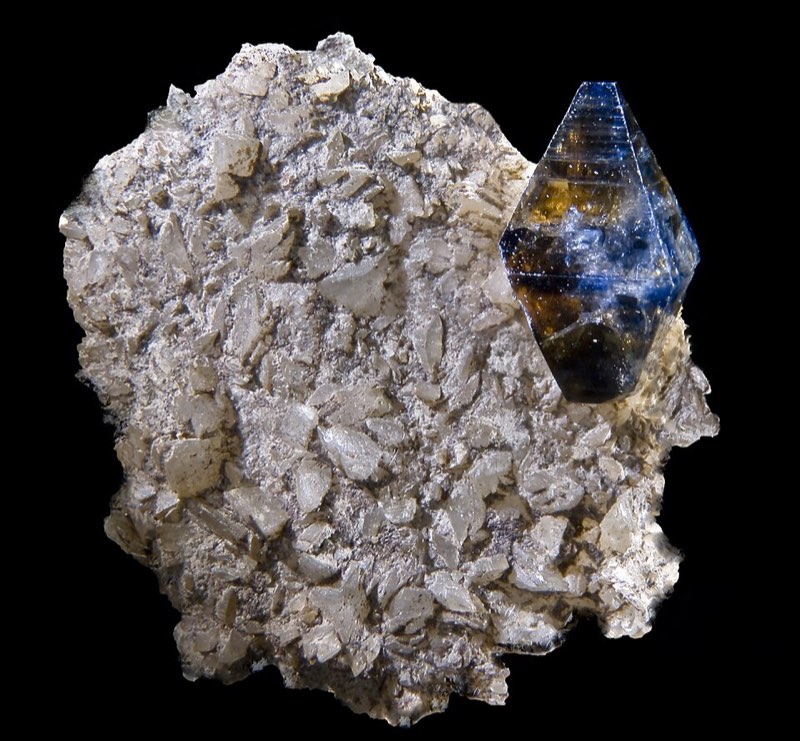
One of the three minerals with the formula TiO₂, with rutile and brookite. It often forms steep blue or brown pyramids.
Photo: Didier Descouens, CC BY-SA 4.0
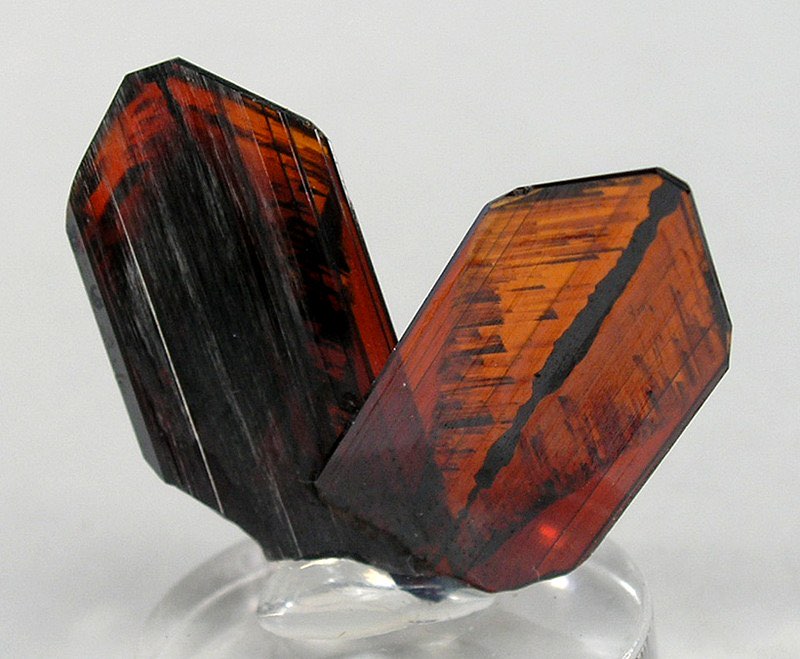
The orthorhombic form of TiO₂, typically thin brown or black plates.
Photo: Robert M. Lavinsky, CC BY-SA 3.0
Key differences
- Brookite forms flat tablets, not steep pyramids.
- Anatase forms steep pyramids rather than plates.
Side by side
| Property | Anatase | Brookite |
|---|---|---|
| Type | Mineral | Mineral |
| Mohs hardness | 5.5–6 | 5.5–6 |
| Luster | Adamantine | Adamantine |
| Streak | White | White |
| Colors | Blue, Brown, Black, Yellow | Brown, Black, Red |
| Crystal system | Tetragonal | Orthorhombic |
| Specific gravity | 3.8–3.9 | 4.1–4.2 |
| Formula | TiO₂ | TiO₂ |
| Found in | Alps, France and Switzerland; Norway | Magnet Cove, Arkansas; Alps |
Properties that are the same for both are grayed out.
How to identify anatase
- Sharp dipyramids, commonly blue, brown or black.
- Brilliant, almost metallic shine.
- Hardness about 5.5–6. White streak, unlike hematite.
Crystal system: Tetragonal
Full Anatase guide →How to identify brookite
- Flat, wafer-like brown to black crystals.
- Strong shine and a white to pale streak.
- Hardness about 5.5–6.
Crystal system: Orthorhombic
Full Brookite guide →More comparisons
Frequently asked questions
What is the difference between anatase and brookite?
Anatase is a mineral (TiO₂) with a Mohs hardness of 5.5–6 and an adamantine luster, usually blue, brown, black or yellow. Brookite is a mineral (TiO₂) with a Mohs hardness of 5.5–6 and an adamantine luster, usually brown, black or red.
How can you tell anatase from brookite?
Brookite forms flat tablets, not steep pyramids. Anatase forms steep pyramids rather than plates.
Could you tell them apart from a blurry close-up?
Play today's Rocksday