 Rocksday
Anatase vs Titanite
To tell Anatase from Titanite: Titanite wedges are softer and are a silicate, not an oxide.
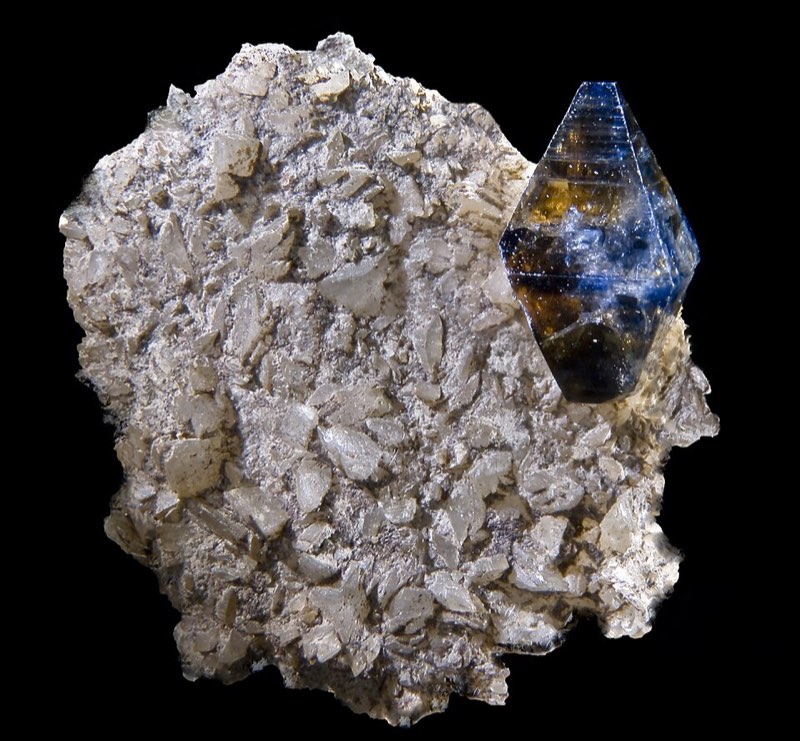
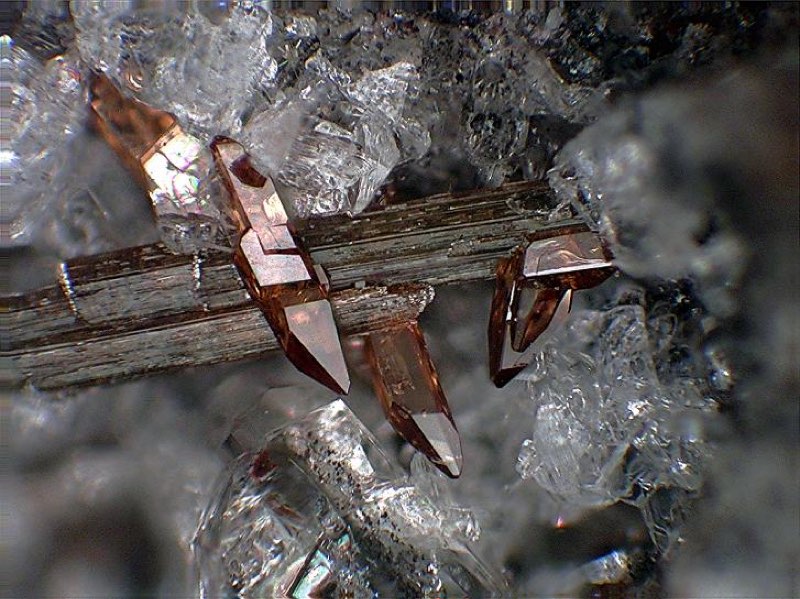
One of the three minerals with the formula TiO₂, with rutile and brookite. It often forms steep blue or brown pyramids.
Photo: Didier Descouens, CC BY-SA 4.0
A calcium titanium silicate famous for wedge-shaped crystals and gems with more fire than diamond.
Photo: Fred Kruijen, CC BY-SA 3.0 nl
Key differences
- Titanite wedges are softer and are a silicate, not an oxide.
Side by side
| Property | Anatase | Titanite |
|---|---|---|
| Type | Mineral | Mineral |
| Mohs hardness | 5.5–6 | 5–5.5 |
| Luster | Adamantine | Adamantine to resinous |
| Streak | White | White |
| Colors | Blue, Brown, Black, Yellow | Yellow, Green, Brown |
| Crystal system | Tetragonal | Monoclinic |
| Specific gravity | 3.8–3.9 | 3.48–3.6 |
| Formula | TiO₂ | CaTiSiO₅ |
| Found in | Alps, France and Switzerland; Norway | Gilgit-Baltistan, Pakistan; Madagascar |
Properties that are the same for both are grayed out.
How to identify anatase
- Sharp dipyramids, commonly blue, brown or black.
- Brilliant, almost metallic shine.
- Hardness about 5.5–6. White streak, unlike hematite.
Crystal system: Tetragonal
Full Anatase guide →How to identify titanite
- Flattened, wedge- or envelope-shaped crystals.
- Bright, almost diamond-like luster.
- Hardness about 5 — a knife scratches it.
Crystal system: Monoclinic
Full Titanite guide →More comparisons
Frequently asked questions
What is the difference between anatase and titanite?
Anatase is a mineral (TiO₂) with a Mohs hardness of 5.5–6 and an adamantine luster, usually blue, brown, black or yellow. Titanite is a mineral (CaTiSiO₅) with a Mohs hardness of 5–5.5 and an adamantine to resinous luster, usually yellow, green or brown.
How can you tell anatase from titanite?
Titanite wedges are softer and are a silicate, not an oxide.
Could you tell them apart from a blurry close-up?
Play today's Rocksday