 Rocksday
Nephrite vs Serpentine
How to tell them apart
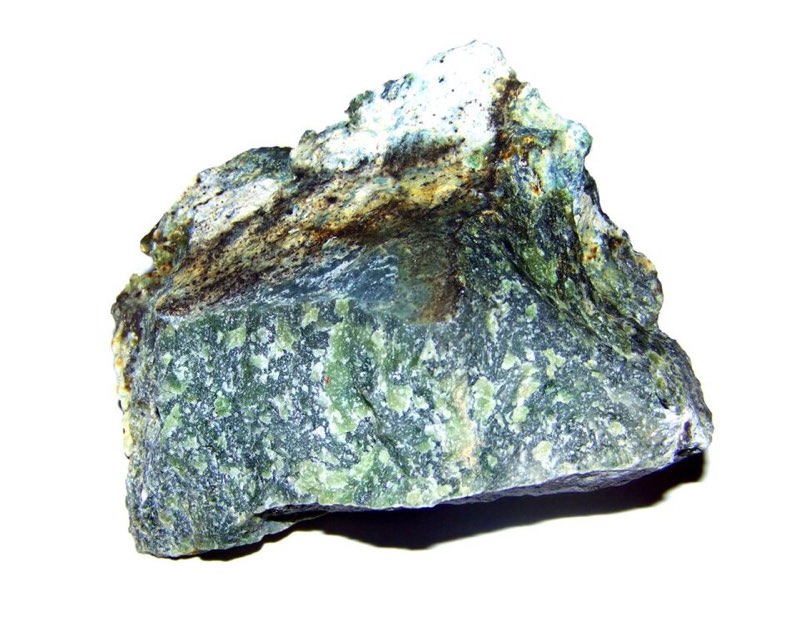
The other jade: a dense mat of interlocking amphibole fibers that makes one of the toughest natural materials.
Photo: Piotr Sosnowski, CC BY-SA 4.0
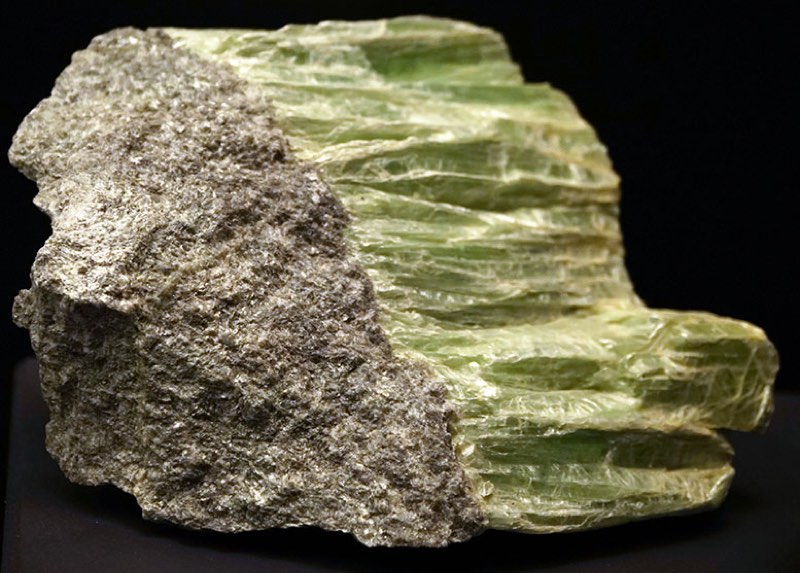
A group of green magnesium silicates formed when mantle rocks react with water. Smooth, greasy and often mottled like snakeskin.
Photo: Tiia Monto, CC BY-SA 3.0
Quick tests
- Scratch glass: Nephrite scratches glass (Mohs 6–6.5); Serpentine can't (Mohs 2.5–5).
Key differences
- Serpentine is softer and lighter.
- Nephrite can't be scratched by a knife.
Side by side
| Property | Nephrite | Serpentine |
|---|---|---|
| Type | Mineral | Mineral |
| Mohs hardness | 6–6.5 | 2.5–5 |
| Luster | Greasy to waxy | Greasy to waxy |
| Streak | White | White |
| Colors | Green, White, Black | Green, Yellow, Black |
| Crystal system | Monoclinic (fibrous) | Monoclinic |
| Specific gravity | 2.9–3.03 | 2.5–2.6 |
| Formula | Ca₂(Mg,Fe)₅Si₈O₂₂(OH)₂ | Mg₃Si₂O₅(OH)₄ |
| Found in | British Columbia, Canada; Hotan, Xinjiang, China | California; Liaoning, China |
Properties that are the same for both are grayed out.
How to identify nephrite
- Extremely tough, with an oily, waxy polish.
- Spinach to olive green, creamy white or black.
- Often found as smooth river boulders.
Crystal system: Monoclinic (fibrous)
Full Nephrite guide →How to identify serpentine
- Mottled green, often with darker streaks.
- Greasy or waxy feel when polished.
- Usually scratched by a knife.
Crystal system: Monoclinic
Full Serpentine guide →More comparisons
Could you tell them apart from a blurry close-up?
Play today's Rocksday