 Rocksday
Millerite vs Rutilated Quartz
How to tell them apart
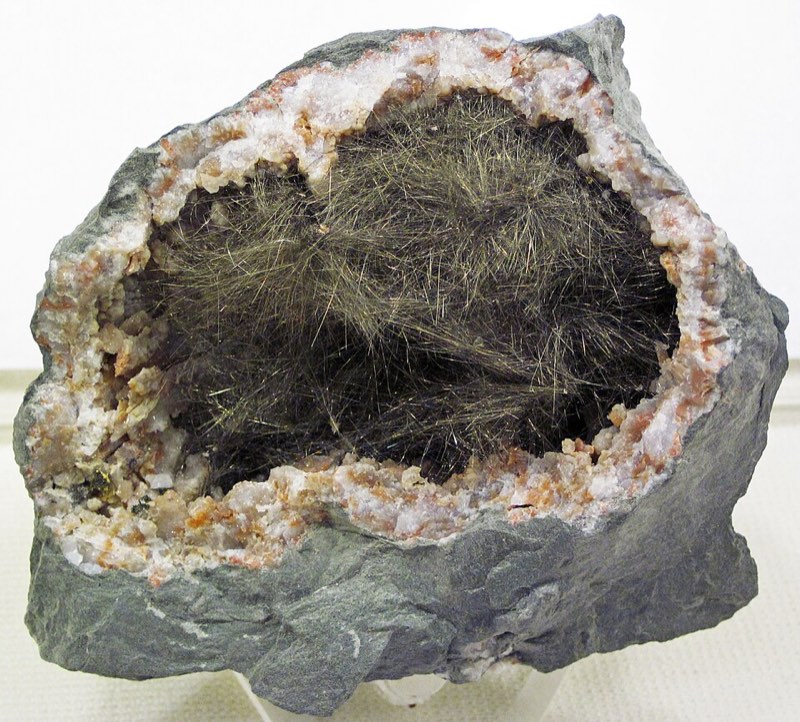
A nickel sulfide that grows as brassy, hair-thin needles, often inside geodes.
Photo: James St. John, CC BY 2.0
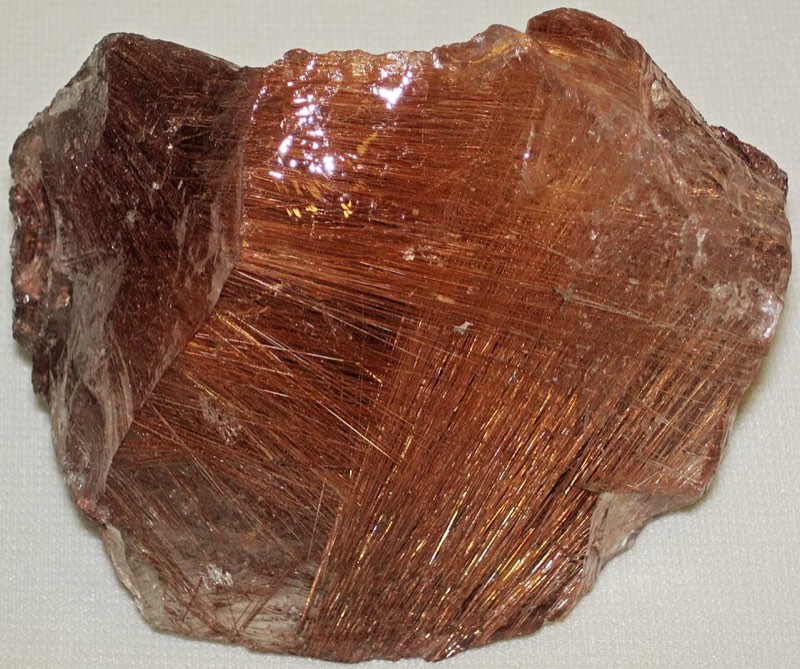
Clear quartz threaded with golden or reddish needles of the mineral rutile.
Photo: James St. John, CC BY 2.0
Quick tests
- Scratch glass: Rutilated Quartz scratches glass (Mohs 7); Millerite can't (Mohs 3–3.5).
- Streak (rub on unglazed porcelain): Millerite leaves a greenish black streak; Rutilated Quartz leaves white.
- Heft: Millerite feels noticeably heavier for its size (specific gravity 5.3–5.5 vs 2.65–2.7).
- Luster: Millerite looks metallic; Rutilated Quartz doesn't.
Key differences
- Rutile needles are trapped inside quartz rather than free-standing.
Side by side
| Property | Millerite | Rutilated Quartz |
|---|---|---|
| Type | Mineral | Mineral |
| Mohs hardness | 3–3.5 | 7 |
| Luster | Metallic | Vitreous |
| Streak | Greenish black | White |
| Colors | Gold | Clear, Gold |
| Crystal system | Trigonal | Trigonal |
| Specific gravity | 5.3–5.5 | 2.65–2.7 |
| Formula | NiS | SiO₂ with TiO₂ needles |
| Found in | Keokuk geodes, Iowa; Halls Gap, Kentucky | Minas Gerais and Bahia, Brazil; Madagascar |
Properties that are the same for both are grayed out.
How to identify millerite
- Brass-yellow hair-like needles in sprays.
- Often inside quartz or calcite geodes.
- Metallic luster.
Crystal system: Trigonal
Full Millerite guide →How to identify rutilated quartz
- Clear quartz with fine gold, copper or black needles inside.
- Hardness 7.
- Needles run in straight lines, often criss-crossing.
Crystal system: Trigonal
Full Rutilated Quartz guide →More comparisons
Could you tell them apart from a blurry close-up?
Play today's Rocksday