 Rocksday
Epidote vs Tourmaline
How to tell them apart
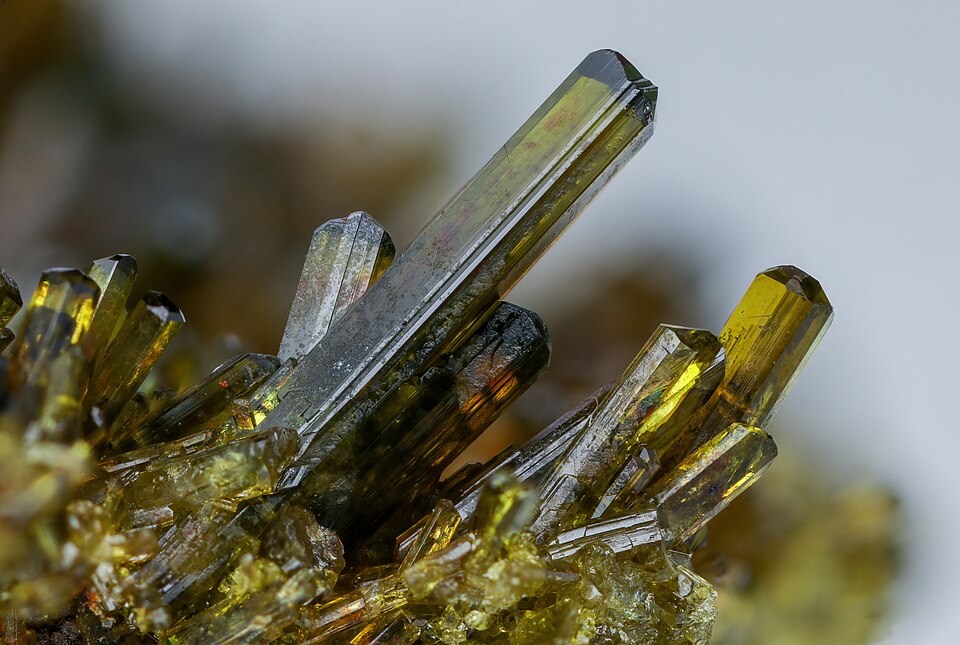
A pistachio-green metamorphic mineral. Mixed with pink feldspar it forms the popular stone 'unakite'.
Photo: Gleb Korovko, CC BY 4.0
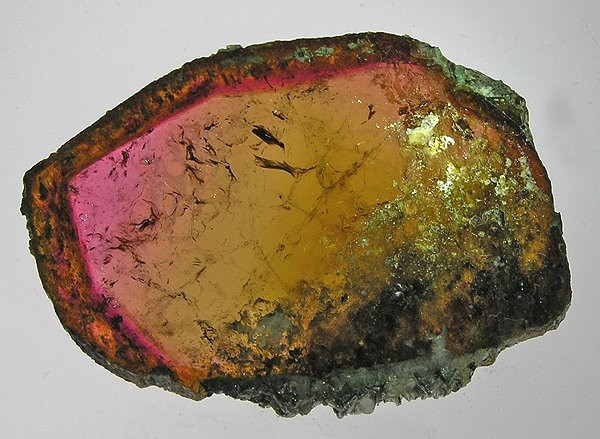
A boron-bearing silicate found in more colors than almost any other gem. Black schorl is the most common form.
Photo: Robert M. Lavinsky, CC BY-SA 3.0
Quick tests
- Streak (rub on unglazed porcelain): Epidote leaves a gray to white streak; Tourmaline leaves white.
Key differences
- Tourmaline has a triangular cross-section.
Side by side
| Property | Epidote | Tourmaline |
|---|---|---|
| Type | Mineral | Mineral |
| Mohs hardness | 6–7 | 7–7.5 |
| Luster | Vitreous | Vitreous |
| Streak | Gray to white | White |
| Colors | Green, Black | Black, Green, Pink |
| Crystal system | Monoclinic | Trigonal |
| Specific gravity | 3.3–3.6 | 3–3.3 |
| Formula | Ca₂(Al₂Fe)(SiO₄)(Si₂O₇)O(OH) | Complex borosilicate |
| Found in | Prince of Wales Island, Alaska; Knappenwand, Austria | Mount Mica, Maine; San Diego County, California |
Properties that are the same for both are grayed out.
How to identify epidote
- Distinctive pistachio to dark green.
- Striated prisms.
- Hardness 6–7.
- Commonly fills cracks in altered rocks.
Crystal system: Monoclinic
Full Epidote guide →How to identify tourmaline
- Long prisms with lengthwise grooves (striations).
- Rounded-triangle cross-section when broken across.
- Hard — scratches glass.
- Gem crystals can change color from end to end ('watermelon').
Crystal system: Trigonal
Full Tourmaline guide →More comparisons
Could you tell them apart from a blurry close-up?
Play today's Rocksday