 Rocksday
Emerald vs Hiddenite
To tell Emerald from Hiddenite: Emerald is harder, hexagonal and has no cleavage.
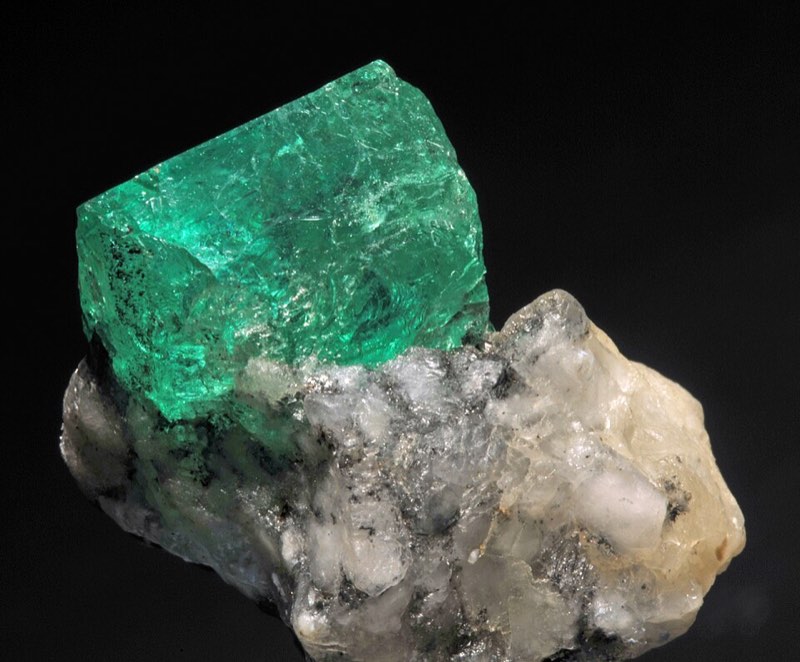
Green beryl colored by chromium or vanadium — one of the four classic precious gems.
Photo: Géry PARENT, CC0
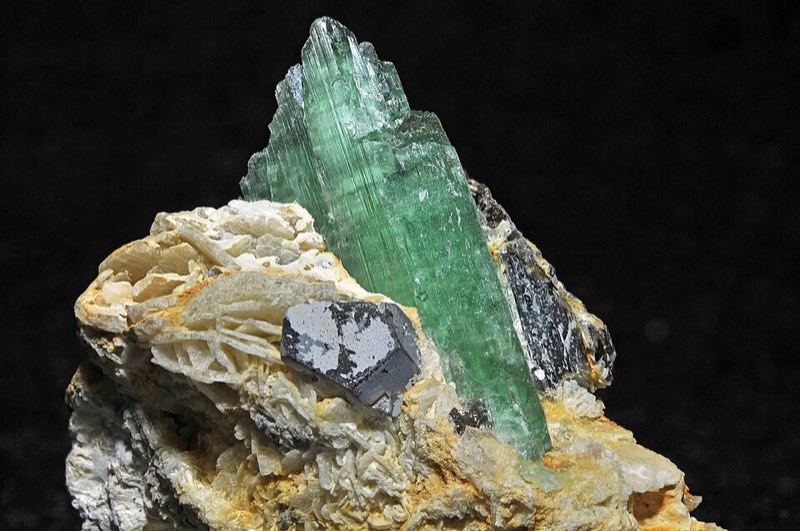
Green spodumene. The original North Carolina stones are colored by chromium; pale green spodumene from elsewhere is often sold under the same name.
Photo: Parent Géry, CC BY-SA 3.0
Key differences
- Emerald is harder, hexagonal and has no cleavage.
Side by side
| Property | Emerald | Hiddenite |
|---|---|---|
| Type | Mineral | Mineral |
| Mohs hardness | 7.5–8 | 6.5–7 |
| Luster | Vitreous | Vitreous |
| Streak | White | White |
| Colors | Green | Green, Yellow |
| Crystal system | Hexagonal | Monoclinic |
| Specific gravity | 2.67–2.78 | 3.1–3.2 |
| Formula | Be₃Al₂Si₆O₁₈ (with Cr/V) | LiAlSi₂O₆ |
| Found in | Muzo and Chivor, Colombia; Kafubu, Zambia | Alexander County, North Carolina; Afghanistan |
Properties that are the same for both are grayed out.
How to identify emerald
- Deep green six-sided prisms with flat ends.
- Almost always has internal fractures and inclusions.
- Hardness 7.5–8.
Crystal system: Hexagonal
Full Emerald guide →How to identify hiddenite
- Yellow-green to emerald-green flattened prisms.
- Two cleavages nearly at right angles.
- Hardness about 6.5–7, so a knife blade does not scratch it.
Crystal system: Monoclinic
Full Hiddenite guide →More comparisons
Frequently asked questions
What is the difference between emerald and hiddenite?
Emerald is a mineral with a Mohs hardness of 7.5–8 and a vitreous luster, usually green. Hiddenite is a mineral (LiAlSi₂O₆) with a Mohs hardness of 6.5–7 and a vitreous luster, usually green or yellow.
How can you tell emerald from hiddenite?
Emerald is harder, hexagonal and has no cleavage.
Could you tell them apart from a blurry close-up?
Play today's Rocksday