 Rocksday
Diorite vs Granite
How to tell them apart
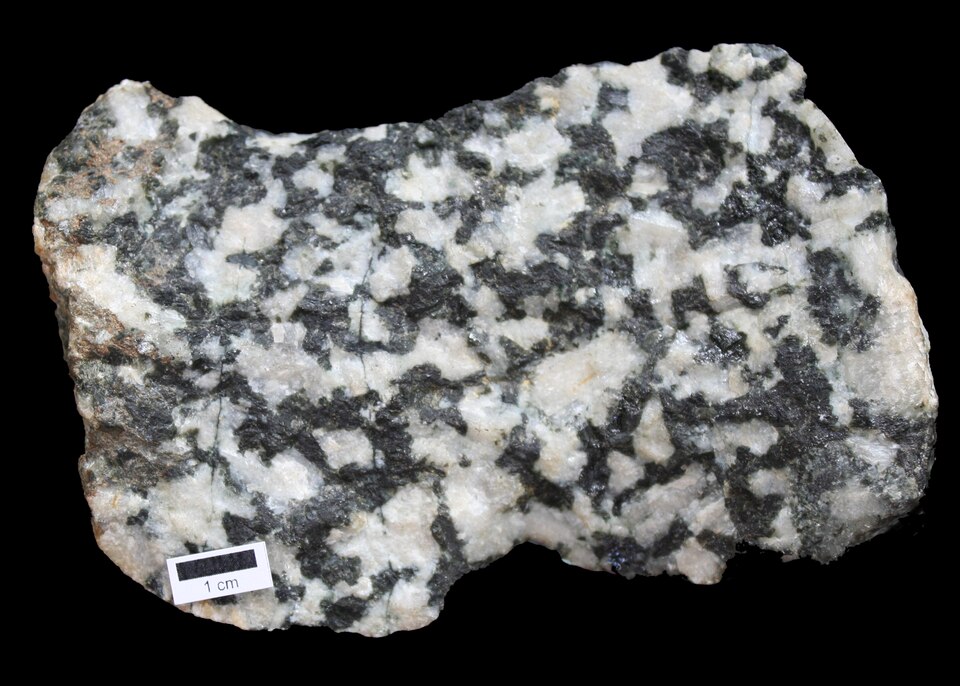
A 'salt-and-pepper' coarse-grained rock of white plagioclase and black hornblende, between granite and gabbro in composition.
Photo: Michael C. Rygel, CC BY-SA 3.0
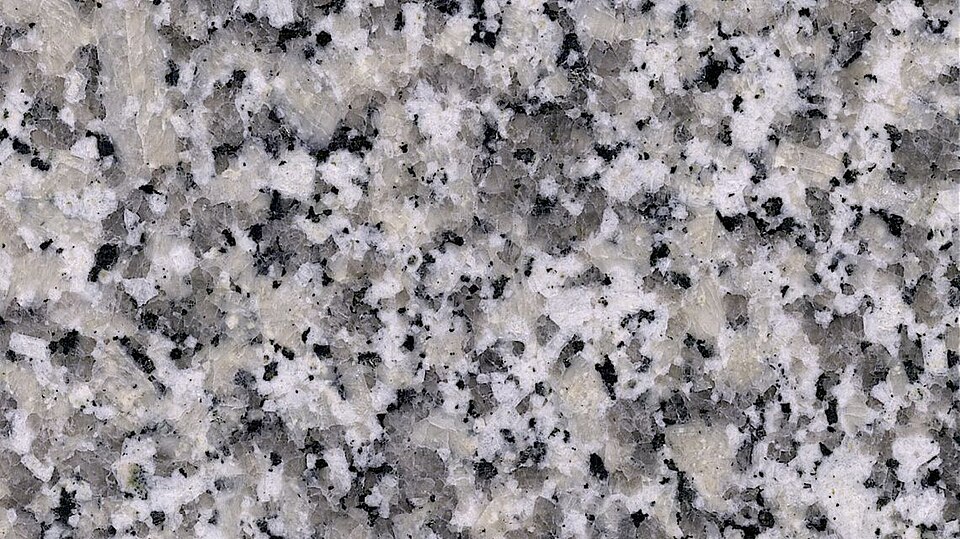
A coarse-grained rock that cooled slowly deep underground, made of quartz, feldspar and mica or hornblende.
Photo: The stone gate, CC BY-SA 4.0
Key differences
- Granite has glassy quartz and often pink feldspar.
- Diorite is black-and-white 'salt and pepper' with little or no quartz.
Side by side
| Property | Diorite | Granite |
|---|---|---|
| Type | Igneous rock | Igneous rock |
| Mohs hardness | 6 | 6–7 |
| Luster | Granular | Granular, sparkly |
| Colors | White, Black, Gray | Pink, Gray, White, Black |
| Crystal system / structure | Coarse-grained (phaneritic) | Coarse-grained (phaneritic) |
| Specific gravity | 2.8–3 | 2.63–2.75 |
| Found in | Guernsey, Channel Islands; Sierra Nevada, California | Sierra Nevada, California; Stone Mountain, Georgia |
Properties that are the same for both are grayed out.
How to identify diorite
- Roughly equal white and black speckles.
- Coarse grains visible by eye.
- Little or no glassy quartz, no pink feldspar.
- Hard and heavy.
Structure: Coarse-grained (phaneritic)
Full Diorite guide →How to identify granite
- Speckled with interlocking grains you can see without a lens.
- Glassy gray quartz plus pink or white blocky feldspar.
- Black specks of mica or hornblende.
- Hard, with no layering or banding.
Structure: Coarse-grained (phaneritic)
Full Granite guide →More comparisons
Could you tell them apart from a blurry close-up?
Play today's Rocksday