 Rocksday
Dioptase vs Linarite
The quickest way to tell Dioptase from Linarite: A fingernail scratches Linarite (Mohs 2.5) but not Dioptase (Mohs 5).
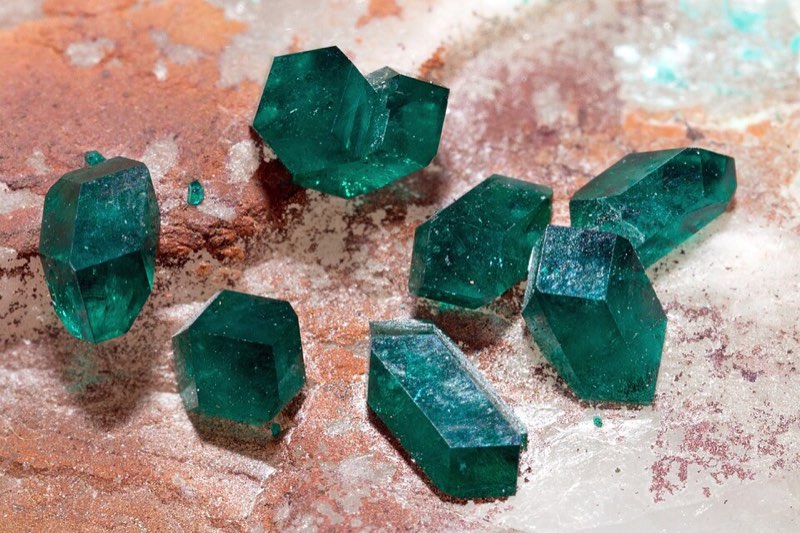
An intensely emerald-green copper silicate that forms glittering short crystals.
Photo: Géry PARENT, CC BY-SA 4.0
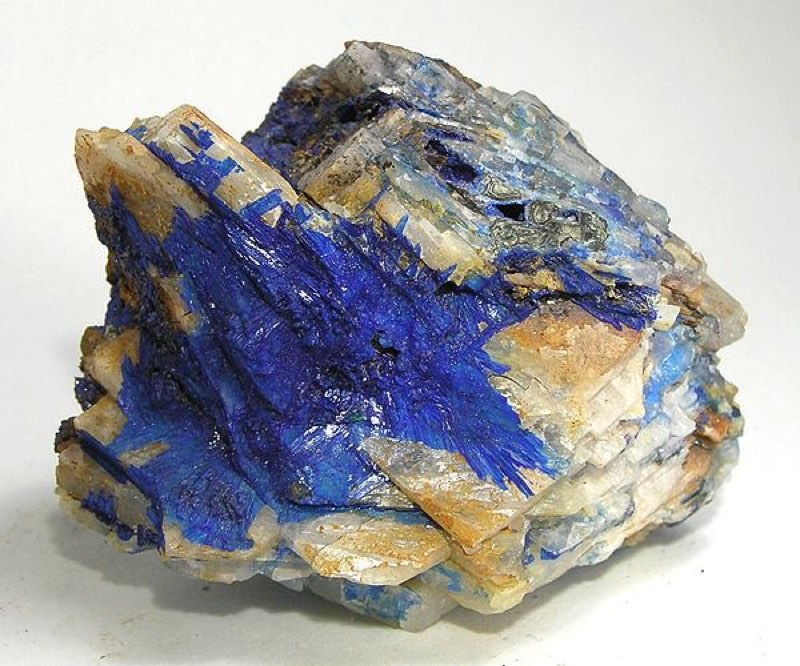
A deep blue lead-copper sulfate, often mistaken for azurite. It does not fizz, and it is much heavier.
Photo: Robert M. Lavinsky, CC BY-SA 3.0
Quick tests
- Fingernail: A fingernail scratches Linarite (Mohs 2.5) but not Dioptase (Mohs 5).
- Streak (rub on unglazed porcelain): Dioptase leaves a green streak; Linarite leaves pale blue.
- Heft: Linarite feels noticeably heavier for its size (specific gravity 5.3–5.4 vs 3.28–3.35).
Key differences
- Dioptase is emerald green, not blue, and harder.
Side by side
| Property | Dioptase | Linarite |
|---|---|---|
| Type | Mineral | Mineral |
| Mohs hardness | 5 | 2.5 |
| Luster | Vitreous | Adamantine to vitreous |
| Streak | Green | Pale blue |
| Colors | Green | Blue |
| Crystal system | Trigonal | Monoclinic |
| Specific gravity | 3.28–3.35 | 5.3–5.4 |
| Formula | CuSiO₂(OH)₂ | PbCu(SO₄)(OH)₂ |
| Found in | Tsumeb, Namibia; Altyn-Tyube, Kazakhstan | Linares, Spain; Arizona |
Properties that are the same for both are grayed out.
How to identify dioptase
- Vivid emerald green, often a sparkling crystal crust.
- Short six-sided crystals with rhombic tips.
- Hardness 5 — a knife scratches it.
Crystal system: Trigonal
Full Dioptase guide →How to identify linarite
- Intense blue crystals or crusts.
- A fingernail almost scratches it.
- No fizz in acid — azurite fizzes.
- Surprisingly heavy.
Crystal system: Monoclinic
Full Linarite guide →More comparisons
Frequently asked questions
What is the difference between dioptase and linarite?
Dioptase is a mineral with a Mohs hardness of 5 and a vitreous luster, usually green. Linarite is a mineral with a Mohs hardness of 2.5 and an adamantine to vitreous luster, usually blue.
How can you tell dioptase from linarite?
A fingernail scratches Linarite (Mohs 2.5) but not Dioptase (Mohs 5). Dioptase leaves a green streak; Linarite leaves pale blue. Linarite feels noticeably heavier for its size (specific gravity 5.3–5.4 vs 3.28–3.35). Dioptase is emerald green, not blue, and harder.
Could you tell them apart from a blurry close-up?
Play today's Rocksday