 Rocksday
Chalcedony vs Larimar
How to tell them apart
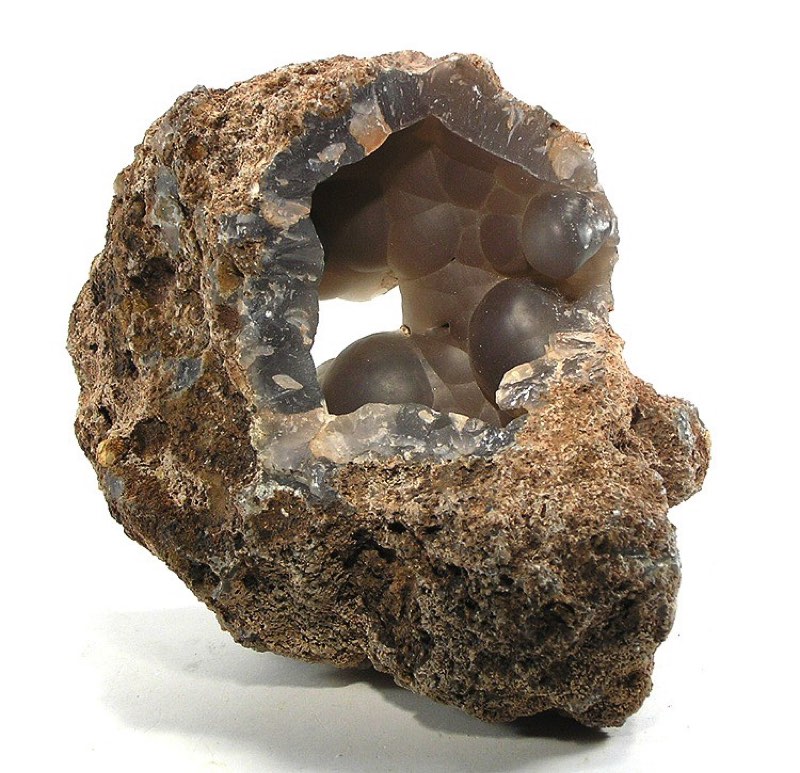
Quartz made of microscopic fibers. Plain chalcedony is soft blue-gray and often grows in bubbly, grape-like crusts.
Photo: Robert M. Lavinsky, CC BY-SA 3.0
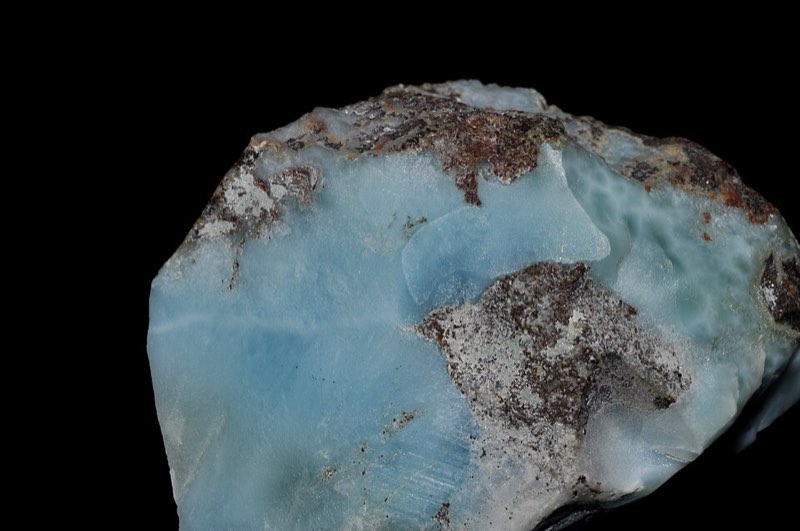
A sky-blue variety of pectolite with white, water-like patterns, found only in the Dominican Republic.
Photo: Parent Géry, Public domain
Quick tests
- Scratch glass: Chalcedony scratches glass (Mohs 6.5–7); Larimar can't (Mohs 4.5–5).
Key differences
- Blue chalcedony is harder and lacks the fibrous patterning.
Side by side
| Property | Chalcedony | Larimar |
|---|---|---|
| Type | Mineral | Mineral |
| Mohs hardness | 6.5–7 | 4.5–5 |
| Luster | Waxy | Silky to vitreous |
| Streak | White | White |
| Colors | Blue, White, Gray | Blue, White |
| Crystal system | Microcrystalline quartz | Triclinic |
| Specific gravity | 2.58–2.64 | 2.74–2.88 |
| Formula | SiO₂ | NaCa₂Si₃O₈(OH) |
| Found in | Oregon; Namibia | Barahona Province, Dominican Republic |
Properties that are the same for both are grayed out.
How to identify chalcedony
- Waxy, translucent and milky.
- Bubbly 'botryoidal' surfaces are common.
- No crystal faces; scratches glass.
Crystal system: Microcrystalline quartz
Full Chalcedony guide →How to identify larimar
- Sky to sea blue with white swirls, like light on water.
- Fibrous texture with a silky sheen.
- Fairly soft — a knife scratches it.
Crystal system: Triclinic
Full Larimar guide →More comparisons
Could you tell them apart from a blurry close-up?
Play today's Rocksday