 Rocksday
Benitoite vs Neptunite
The quickest way to tell Benitoite from Neptunite: Benitoite leaves a white streak; Neptunite leaves reddish brown.
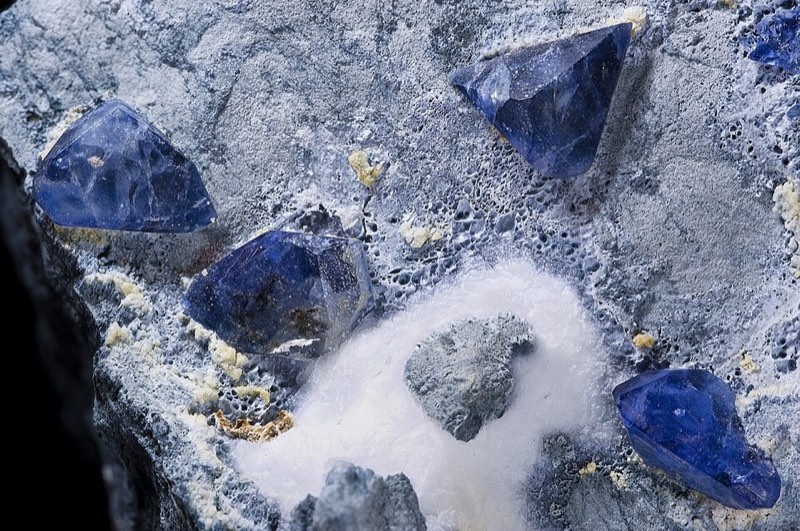
A rare blue barium titanium silicate with distinctive triangular crystals.
Photo: Didier Descouens, CC BY-SA 4.0
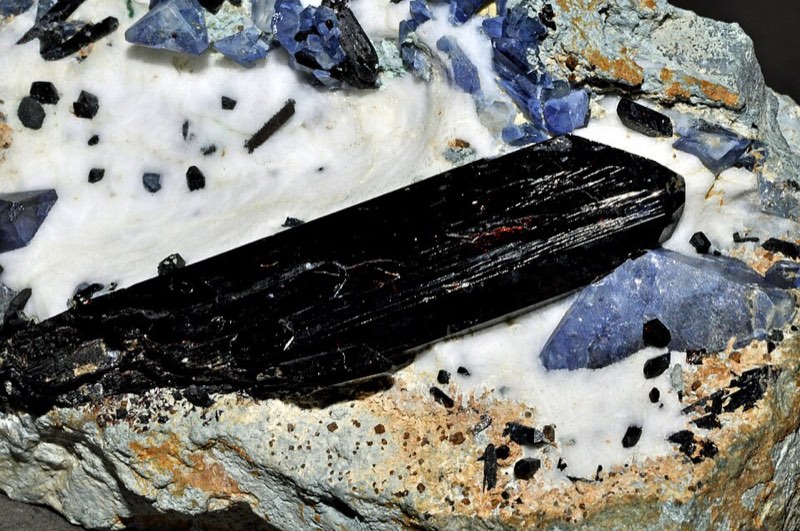
Black prisms that are deep red on thin edges, famous on white natrolite beside blue benitoite.
Photo: Géry PARENT, Public domain
Quick tests
- Streak (rub on unglazed porcelain): Benitoite leaves a white streak; Neptunite leaves reddish brown.
Key differences
- Benitoite on the same rock is blue and fluoresces; neptunite is the black one.
Side by side
| Property | Benitoite | Neptunite |
|---|---|---|
| Type | Mineral | Mineral |
| Mohs hardness | 6–6.5 | 5–6 |
| Luster | Vitreous | Vitreous |
| Streak | White | Reddish brown |
| Colors | Blue, White | Black, Red |
| Crystal system | Hexagonal | Monoclinic |
| Specific gravity | 3.6–3.7 | 3.2–3.3 |
| Formula | BaTiSi₃O₉ | KNa₂Li(Fe,Mn)₂Ti₂Si₈O₂₄ |
| Found in | San Benito County, California | San Benito County, California; Kola Peninsula, Russia |
Properties that are the same for both are grayed out.
How to identify benitoite
- Sapphire-blue triangular crystals.
- Glows brilliant blue under shortwave UV light.
- Usually on white natrolite.
Crystal system: Hexagonal
Full Benitoite guide →How to identify neptunite
- Square-ish black prisms; thin edges glow red.
- Reddish-brown streak.
- Hardness about 5–6.
Crystal system: Monoclinic
Full Neptunite guide →More comparisons
Frequently asked questions
What is the difference between benitoite and neptunite?
Benitoite is a mineral (BaTiSi₃O₉) with a Mohs hardness of 6–6.5 and a vitreous luster, usually blue or white. Neptunite is a mineral with a Mohs hardness of 5–6 and a vitreous luster, usually black or red.
How can you tell benitoite from neptunite?
Benitoite leaves a white streak; Neptunite leaves reddish brown. Benitoite on the same rock is blue and fluoresces; neptunite is the black one.
Could you tell them apart from a blurry close-up?
Play today's Rocksday