 Rocksday
Axinite vs Smoky Quartz
To tell Axinite from Smoky Quartz: Smoky quartz has no wedge habit and no cleavage.
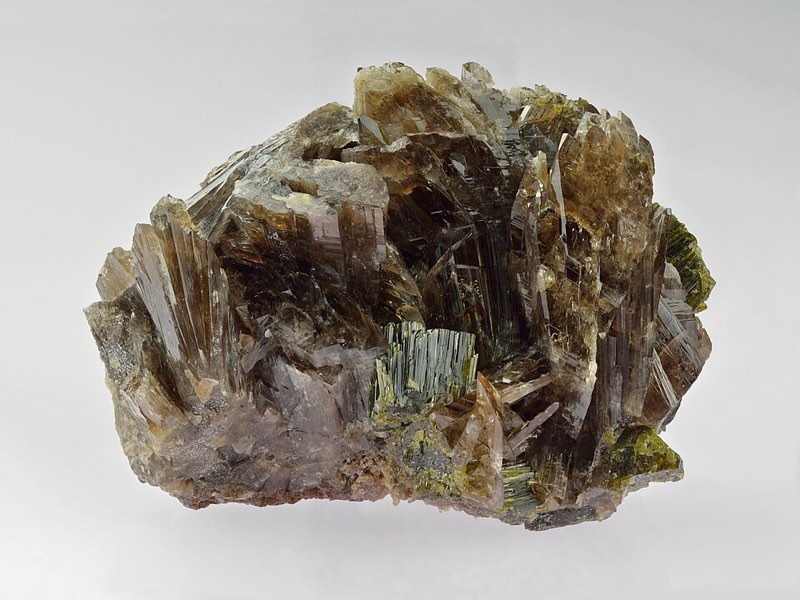
A borosilicate that forms sharp, clove-brown wedges. The name comes from the axe-like shape.
Photo: Ivar Leidus, CC BY-SA 4.0
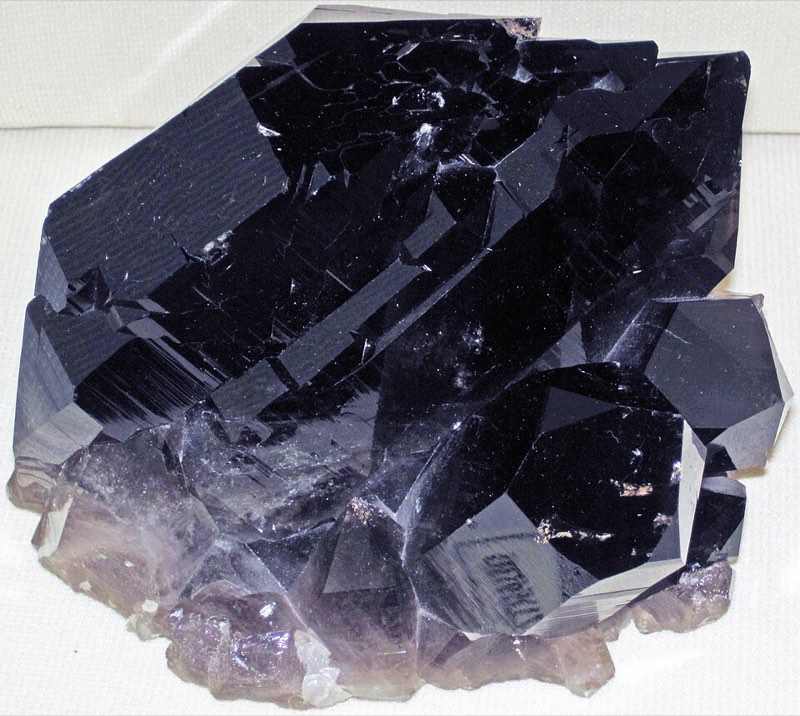
Brown to nearly black quartz colored by natural radiation acting on traces of aluminum.
Photo: James St. John, CC BY 2.0
Key differences
- Smoky quartz has no wedge habit and no cleavage.
Side by side
| Property | Axinite | Smoky Quartz |
|---|---|---|
| Type | Mineral | Mineral |
| Mohs hardness | 6.5–7 | 7 |
| Luster | Vitreous | Vitreous |
| Streak | White | White |
| Colors | Brown, Purple, Gray | Brown, Gray, Black |
| Crystal system | Triclinic | Trigonal |
| Specific gravity | 3.2–3.3 | 2.65 |
| Formula | Ca₂(Fe,Mn)Al₂BSi₄O₁₅(OH) | SiO₂ |
| Found in | Bourg d'Oisans, France; Dalnegorsk, Russia | Swiss Alps; Cairngorm Mountains, Scotland |
Properties that are the same for both are grayed out.
How to identify axinite
- Thin wedge or axe-head crystals, usually brown with a violet tint.
- Hardness about 6.5–7.
- Strongly glassy.
Crystal system: Triclinic
Full Axinite guide →How to identify smoky quartz
- Transparent to translucent brown or gray quartz.
- Six-sided prisms with pointed ends.
- Hardness 7 and no cleavage.
Crystal system: Trigonal
Full Smoky Quartz guide →More comparisons
Frequently asked questions
What is the difference between axinite and smoky quartz?
Axinite is a mineral with a Mohs hardness of 6.5–7 and a vitreous luster, usually brown, purple or gray. Smoky Quartz is a mineral (SiO₂) with a Mohs hardness of 7 and a vitreous luster, usually brown, gray or black.
How can you tell axinite from smoky quartz?
Smoky quartz has no wedge habit and no cleavage.
Could you tell them apart from a blurry close-up?
Play today's Rocksday