 Rocksday
Aurichalcite vs Rosasite
How to tell them apart
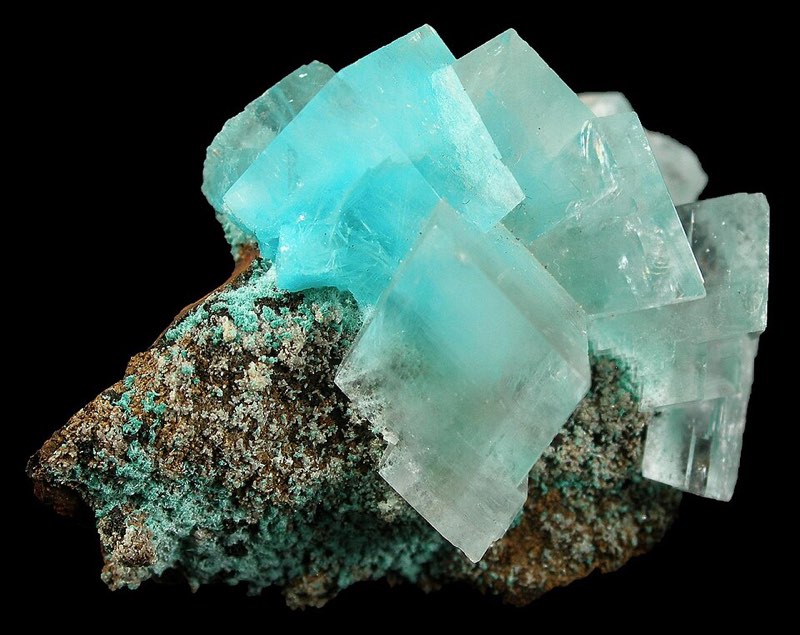
A zinc copper carbonate forming delicate tufts of pale blue-green needles.
Photo: Robert M. Lavinsky, CC BY-SA 3.0
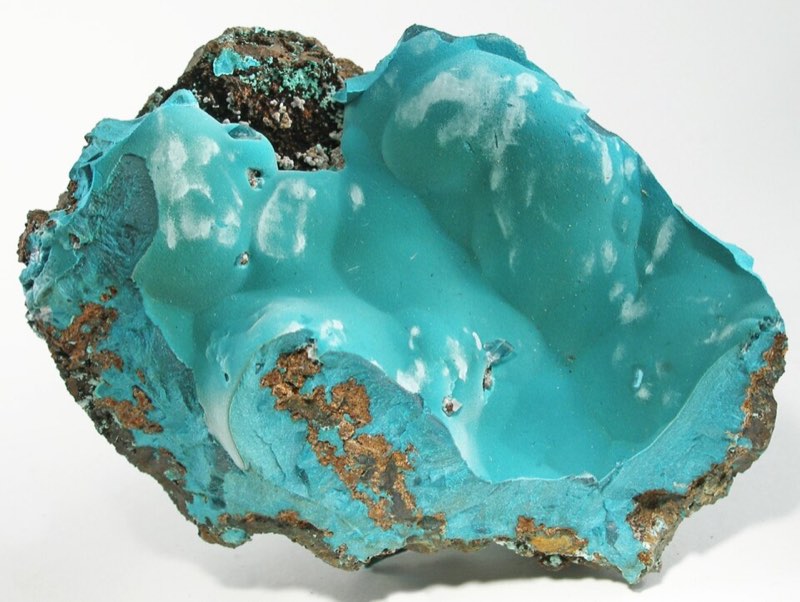
A copper zinc carbonate forming small blue-green balls of radiating fibers.
Photo: Robert M. Lavinsky, CC BY-SA 3.0
Quick tests
- Fingernail: A fingernail scratches Aurichalcite (Mohs 1–2) but not Rosasite (Mohs 4).
- Streak (rub on unglazed porcelain): Aurichalcite leaves a pale blue streak; Rosasite leaves light blue.
Key differences
- Rosasite forms round balls rather than tufts.
- Aurichalcite forms feathery tufts.
Side by side
| Property | Aurichalcite | Rosasite |
|---|---|---|
| Type | Mineral | Mineral |
| Mohs hardness | 1–2 | 4 |
| Luster | Silky to pearly | Silky to vitreous |
| Streak | Pale blue | Light blue |
| Colors | Blue, Green | Blue, Green |
| Crystal system | Orthorhombic | Monoclinic |
| Specific gravity | 3.96 | 4–4.2 |
| Formula | (Zn,Cu)₅(CO₃)₂(OH)₆ | (Cu,Zn)₂CO₃(OH)₂ |
| Found in | Ojuela mine, Mapimí, Mexico; Arizona | Ojuela mine, Mexico; Rosas mine, Sardinia |
Properties that are the same for both are grayed out.
How to identify aurichalcite
- Soft, feathery tufts of sky blue to green needles.
- Pearly sheen.
- Fizzes in acid.
Crystal system: Orthorhombic
Full Aurichalcite guide →How to identify rosasite
- Blue-green spheres, often on brown limonite.
- Radiating fibers inside when broken.
- Fizzes in acid.
Crystal system: Monoclinic
Full Rosasite guide →More comparisons
Could you tell them apart from a blurry close-up?
Play today's Rocksday