 Rocksday
Aurichalcite vs Chrysocolla
How to tell them apart
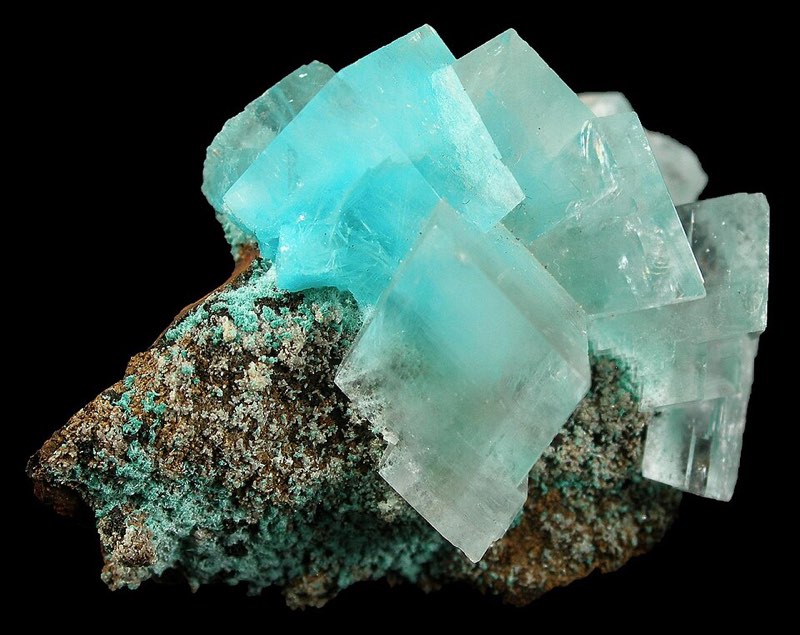
A zinc copper carbonate forming delicate tufts of pale blue-green needles.
Photo: Robert M. Lavinsky, CC BY-SA 3.0
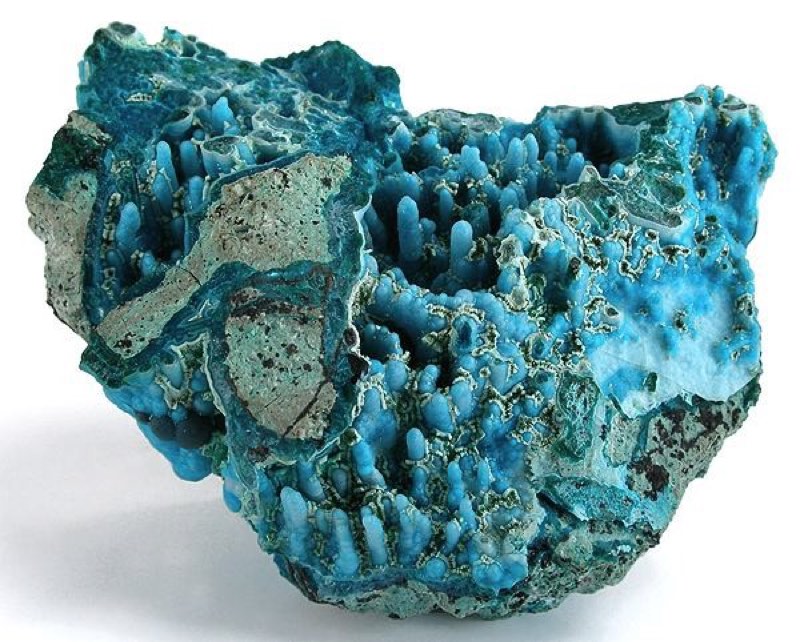
A blue-green hydrated copper silicate that forms crusts and fillings where copper deposits weather.
Photo: Robert M. Lavinsky, CC BY-SA 3.0
Quick tests
- Hardness: Chrysocolla is clearly harder: Mohs 2.5–3.5 versus 1–2.
- Acid (vinegar or dilute HCl): Aurichalcite fizzes; Chrysocolla doesn't.
- Streak (rub on unglazed porcelain): Aurichalcite leaves a pale blue streak; Chrysocolla leaves pale blue to white.
- Heft: Aurichalcite feels noticeably heavier for its size (specific gravity 3.96 vs 1.9–2.4).
Key differences
- Chrysocolla forms smooth crusts, not needles.
Side by side
| Property | Aurichalcite | Chrysocolla |
|---|---|---|
| Type | Mineral | Mineral |
| Mohs hardness | 1–2 | 2.5–3.5 |
| Luster | Silky to pearly | Vitreous to earthy |
| Streak | Pale blue | Pale blue to white |
| Colors | Blue, Green | Blue, Green |
| Crystal system | Orthorhombic | Amorphous to cryptocrystalline |
| Specific gravity | 3.96 | 1.9–2.4 |
| Formula | (Zn,Cu)₅(CO₃)₂(OH)₆ | (Cu,Al)₂H₂Si₂O₅(OH)₄·nH₂O |
| Found in | Ojuela mine, Mapimí, Mexico; Arizona | Arizona; Peru |
Properties that are the same for both are grayed out.
How to identify aurichalcite
- Soft, feathery tufts of sky blue to green needles.
- Pearly sheen.
- Fizzes in acid.
Crystal system: Orthorhombic
Full Aurichalcite guide →How to identify chrysocolla
- Vivid blue to blue-green, often mixed with malachite or quartz.
- Soft and light; may stick slightly to the tongue.
- No crystals — crusts, veins and botryoidal masses.
Crystal system: Amorphous to cryptocrystalline
Full Chrysocolla guide →More comparisons
Could you tell them apart from a blurry close-up?
Play today's Rocksday