 Rocksday
Aquamarine vs Topaz
How to tell them apart
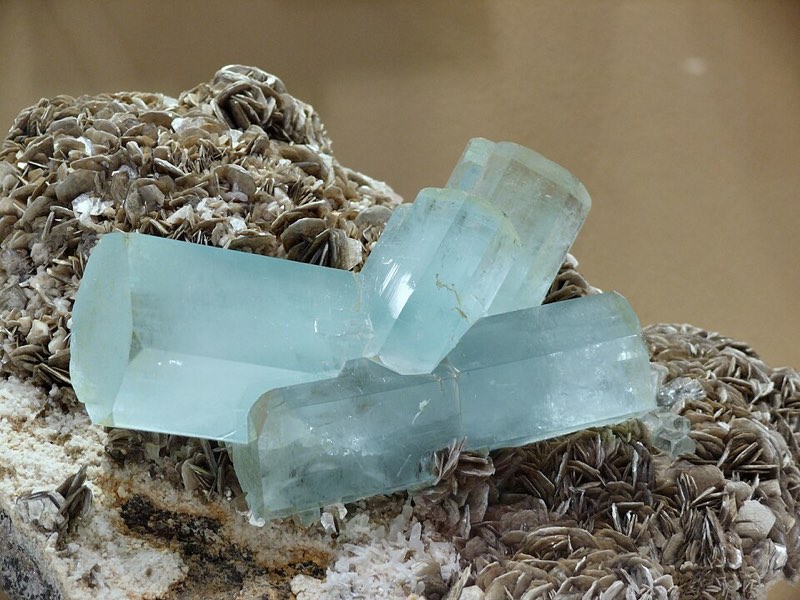
Pale blue to sea-green beryl, often growing as clean, long hexagonal crystals.
Photo: Gunnar Ries Amphibol, CC BY-SA 2.5
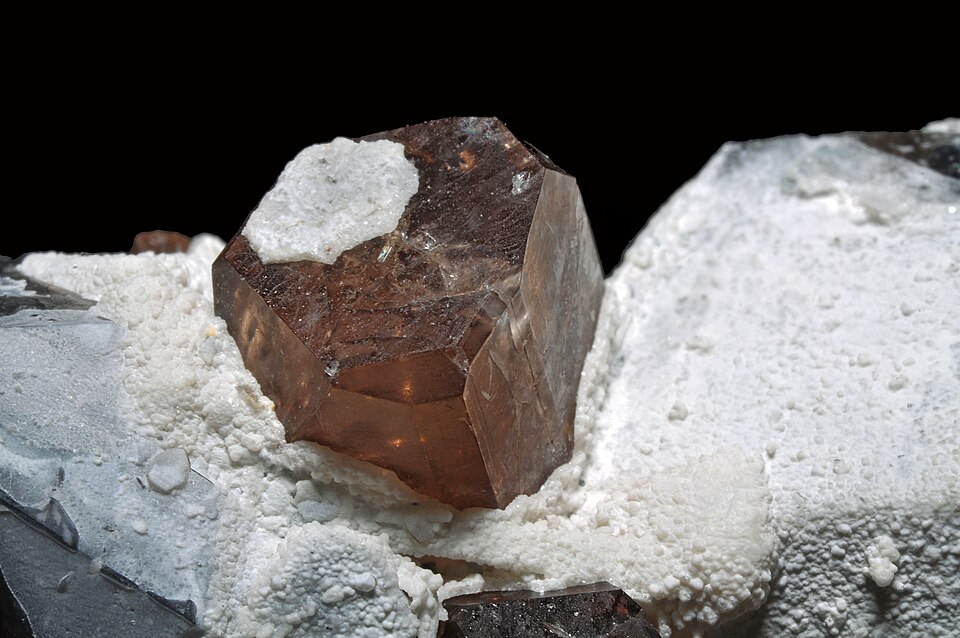
A fluorine-bearing silicate and the Mohs reference for hardness 8. Crystals are often clear with sharp, diamond-shaped cross-sections.
Photo: Parent Géry, CC BY-SA 3.0
Key differences
- Blue topaz is heavier and has a perfect cleavage.
Side by side
| Property | Aquamarine | Topaz |
|---|---|---|
| Type | Mineral | Mineral |
| Mohs hardness | 7.5–8 | 8 |
| Luster | Vitreous | Vitreous |
| Streak | White | White |
| Colors | Blue, Green | Clear, Yellow, Orange, Blue, Pink |
| Crystal system | Hexagonal | Orthorhombic |
| Specific gravity | 2.66–2.8 | 3.49–3.57 |
| Formula | Be₃Al₂Si₆O₁₈ (with Fe) | Al₂SiO₄(F,OH)₂ |
| Found in | Minas Gerais, Brazil; Shigar Valley, Pakistan | Ouro Preto, Brazil; Topaz Mountain, Utah |
Properties that are the same for both are grayed out.
How to identify aquamarine
- Sea-blue, glassy six-sided prisms.
- Hardness 7.5–8.
- Often very clean and transparent.
Crystal system: Hexagonal
Full Aquamarine guide →How to identify topaz
- Harder than quartz (8).
- One perfect cleavage across the crystal — flat, mirror-like breaks.
- Feels heavier than quartz of the same size.
- Prisms with lengthwise striations.
Crystal system: Orthorhombic
Full Topaz guide →More comparisons
Could you tell them apart from a blurry close-up?
Play today's Rocksday