 Rocksday
Olivine vs Pallasite
The quickest way to tell Olivine from Pallasite: A magnet sticks to Pallasite but not to Olivine.
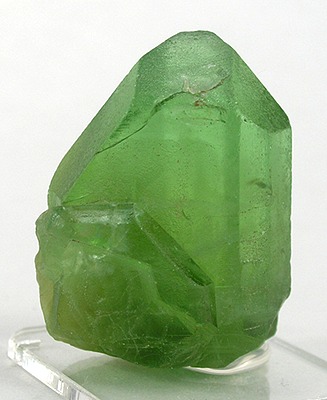
Olive-green silicate that makes up most of Earth's upper mantle. Gem-quality olivine is called peridot.
Photo: Robert M. Lavinsky, CC BY-SA 3.0
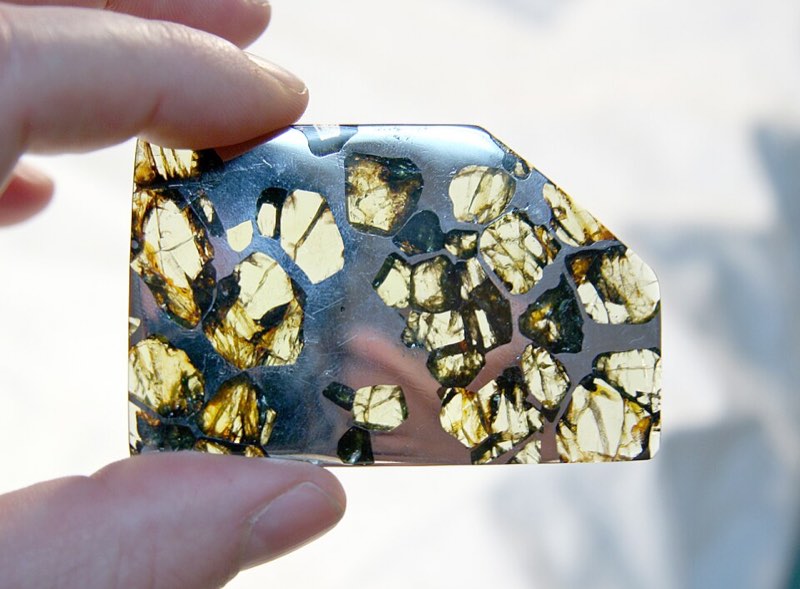
A stony-iron meteorite: gemmy olivine crystals set in nickel-iron, widely interpreted as material from the boundary of an asteroid's core and mantle.
Photo: Doug Bowman, CC BY 2.0
Quick tests
- Magnet: A magnet sticks to Pallasite but not to Olivine.
- Streak (rub on unglazed porcelain): Olivine leaves a white streak; Pallasite leaves gray.
- Heft: Pallasite feels noticeably heavier for its size (specific gravity 4.5–7 vs 3.2–4.4).
- Luster: Pallasite looks metallic; Olivine doesn't.
- Texture: Pallasite is a rock — a mix of grains or minerals; Olivine is a single mineral.
Key differences
- Peridot is the mineral alone, with no nickel-iron mesh.
Side by side
| Property | Olivine | Pallasite |
|---|---|---|
| Type | Mineral | Igneous rock |
| Mohs hardness | 6.5–7 | 4–7 |
| Luster | Vitreous | Metallic and vitreous |
| Streak | White | Gray |
| Colors | Green, Yellow | Green, Yellow, Gray, Silver |
| Crystal system / structure | Orthorhombic | Olivine crystals in nickel-iron |
| Specific gravity | 3.2–4.4 | 4.5–7 |
| Formula | (Mg,Fe)₂SiO₄ | — |
| Found in | Papakōlea, Hawaii; San Carlos, Arizona | Brenham, Kansas; Esquel, Argentina |
Properties that are the same for both are grayed out.
How to identify olivine
- Bottle- to olive-green glassy grains.
- Often as sugary green clumps in black basalt.
- No cleavage — breaks like glass.
- Hard enough to scratch glass.
Crystal system: Orthorhombic
Full Olivine guide →How to identify pallasite
- Translucent green or yellow olivine in a metal network.
- A magnet sticks to the metal.
- Heavier than a terrestrial rock of the same size.
Structure: Olivine crystals in nickel-iron
Full Pallasite guide →More comparisons
Frequently asked questions
What is the difference between olivine and pallasite?
Olivine is a mineral with a Mohs hardness of 6.5–7 and a vitreous luster, usually green or yellow. Pallasite is an igneous rock with a Mohs hardness of about 4–7 and a metallic and vitreous luster, usually green, yellow, gray or silvery.
How can you tell olivine from pallasite?
A magnet sticks to Pallasite but not to Olivine. Olivine leaves a white streak; Pallasite leaves gray. Pallasite feels noticeably heavier for its size (specific gravity 4.5–7 vs 3.2–4.4). Pallasite looks metallic; Olivine doesn't. Pallasite is a rock — a mix of grains or minerals; Olivine is a single mineral. Peridot is the mineral alone, with no nickel-iron mesh.
Could you tell them apart from a blurry close-up?
Play today's Rocksday