 Rocksday
Okenite vs Scolecite
How to tell them apart
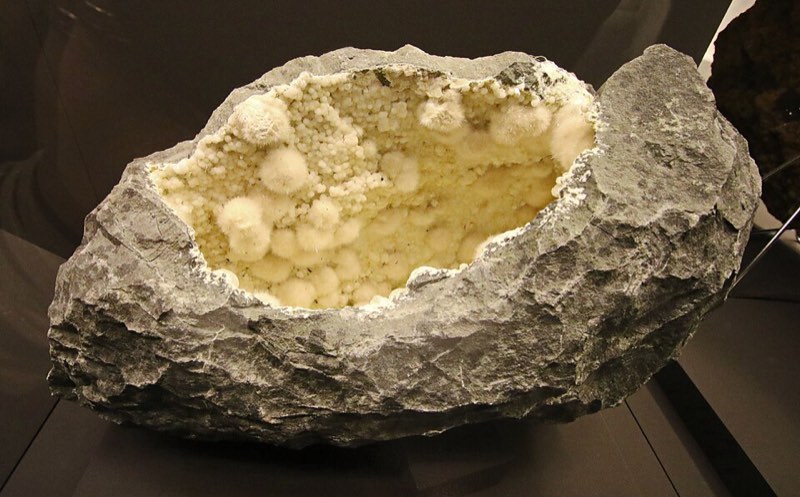
Puffballs of fine white fibers that look like cotton or snowballs inside basalt cavities.
Photo: Kora27, CC BY-SA 4.0
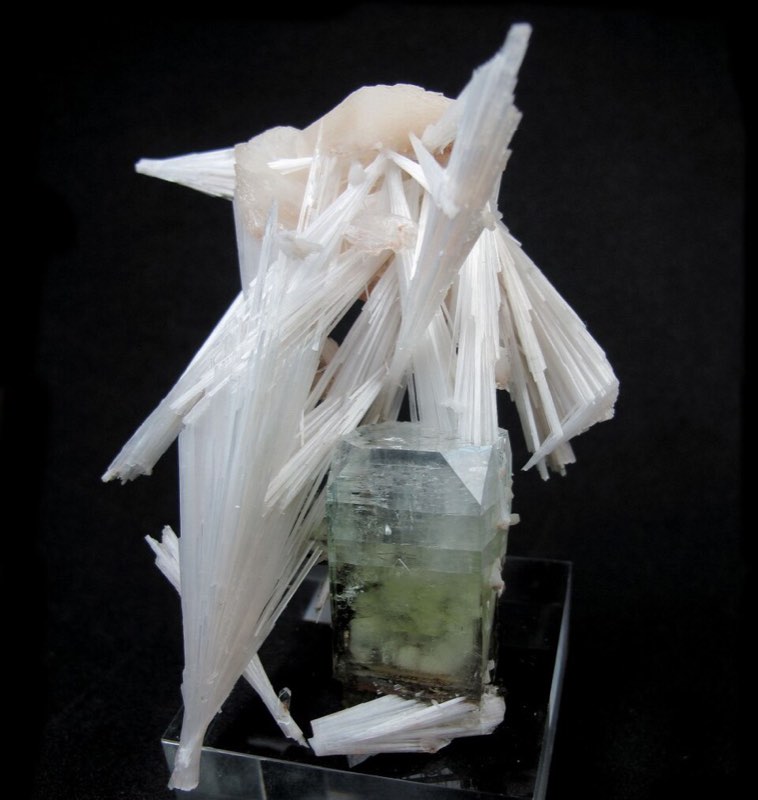
A zeolite forming sprays of slender, glassy white needles.
Photo: Carles Millan, CC BY 3.0
Key differences
- Scolecite needles are stiff and glassy.
- Okenite fibers are fluffy and soft, like cotton.
Side by side
| Property | Okenite | Scolecite |
|---|---|---|
| Type | Mineral | Mineral |
| Mohs hardness | 4.5–5 | 5–5.5 |
| Luster | Silky | Vitreous to silky |
| Streak | White | White |
| Colors | White | White, Clear |
| Crystal system | Triclinic | Monoclinic |
| Specific gravity | 2.28–2.33 | 2.25–2.29 |
| Formula | CaSi₂O₄(OH)₂·H₂O | CaAl₂Si₃O₁₀·3H₂O |
| Found in | Pune, India; Greenland | Pune, India; Iceland |
Properties that are the same for both are grayed out.
How to identify okenite
- Fluffy white fiber balls, soft to the eye.
- Fibers flatten when touched — handle by the matrix.
- Often with green apophyllite or quartz.
Crystal system: Triclinic
Full Okenite guide →How to identify scolecite
- Radiating sprays of thin, straight white needles.
- Often with apophyllite or stilbite.
- Brittle needles snap easily.
Crystal system: Monoclinic
Full Scolecite guide →More comparisons
Could you tell them apart from a blurry close-up?
Play today's Rocksday