 Rocksday
Gabbro vs Larvikite
How to tell them apart
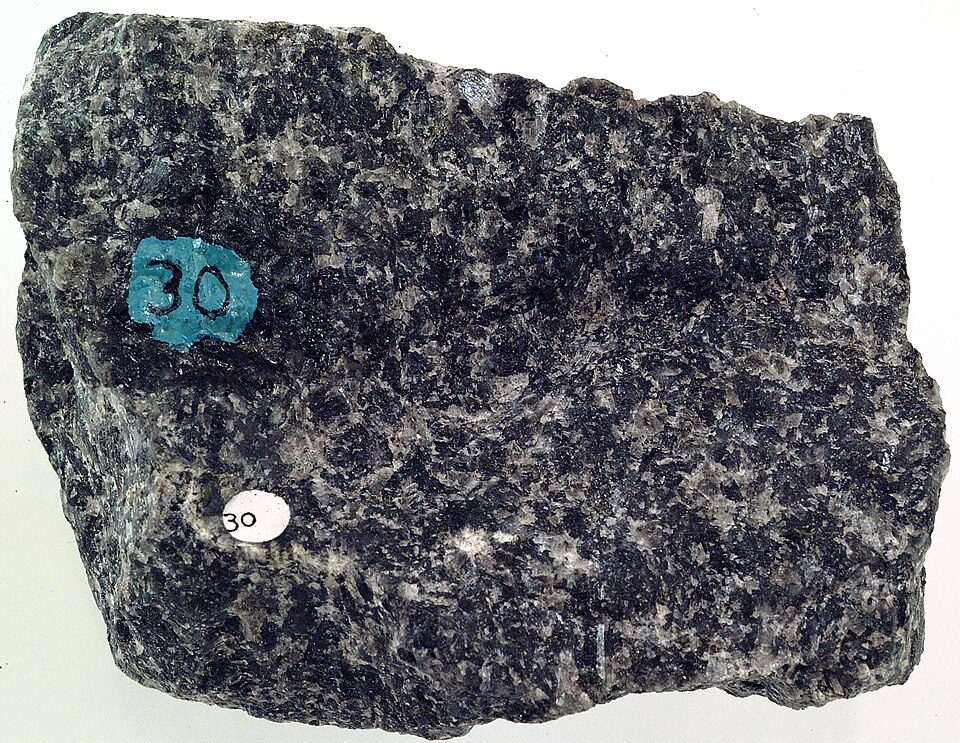
A dark, coarse-grained rock made of pyroxene and plagioclase — basalt that cooled slowly underground.
Photo: Darla Sondrol, CC0
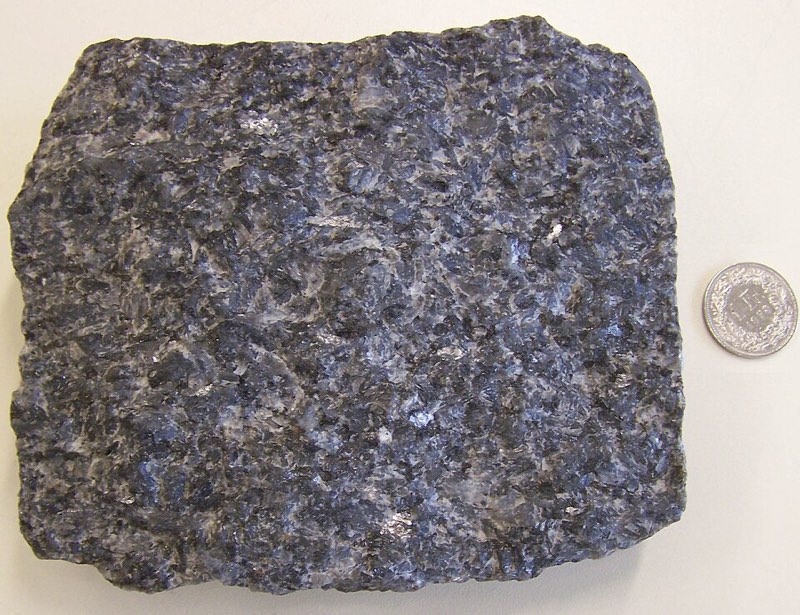
A dark Norwegian monzonite whose feldspar crystals flash silvery blue.
Photo: Woudloper, Public domain
Key differences
- Gabbro lacks the blue sheen.
Side by side
| Property | Gabbro | Larvikite |
|---|---|---|
| Type | Igneous rock | Igneous rock |
| Mohs hardness | 6–6.5 | 6 |
| Luster | Granular | Granular with blue flashes |
| Colors | Black, Gray, Green | Gray, Black, Blue |
| Crystal system / structure | Coarse-grained (phaneritic) | Coarse-grained |
| Specific gravity | 2.9–3.1 | 2.6–2.8 |
| Found in | Duluth Complex, Minnesota; Cuillin, Isle of Skye | Larvik, Norway |
Properties that are the same for both are grayed out.
How to identify gabbro
- Dark gray to black with visible crystals.
- Heavy.
- Little or no quartz.
- Gray plagioclase may show faint parallel lines.
Structure: Coarse-grained (phaneritic)
Full Gabbro guide →How to identify larvikite
- Dark gray with large feldspar crystals.
- Silver-blue flashes when turned in light.
- Little or no quartz.
Structure: Coarse-grained
Full Larvikite guide →More comparisons
Could you tell them apart from a blurry close-up?
Play today's Rocksday