 Rocksday
Crinoid vs Petoskey Stone
How to tell them apart
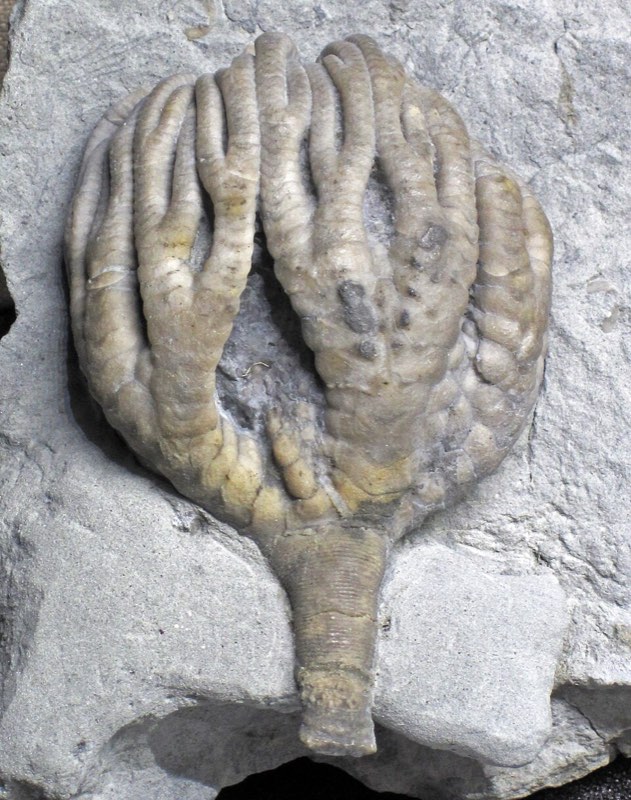
Fossil sea lilies — animals related to starfish — usually found as stacked, button-shaped stem pieces.
Photo: James St. John, CC BY 2.0
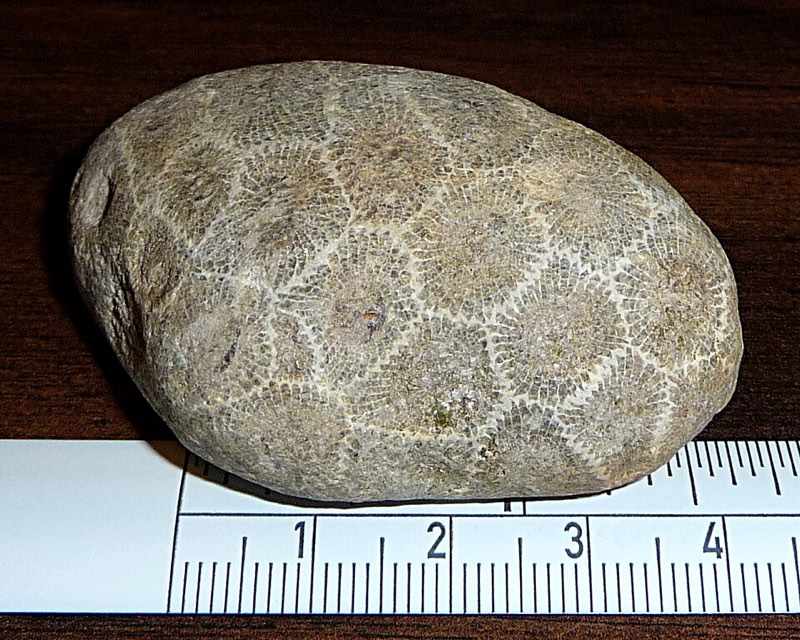
A fossilized colonial coral, about 350 million years old, with a honeycomb of six-sided cells.
Photo: David J. Fred (Dfred), CC BY 3.0
Key differences
- Petoskey stones show a honeycomb of six-sided coral cells.
- Crinoids form round discs, not a honeycomb.
Side by side
| Property | Crinoid | Petoskey Stone |
|---|---|---|
| Type | Fossil | Fossil |
| Mohs hardness | 3 | 3–4 |
| Luster | Dull | Dull (polishes to a shine) |
| Colors | Gray, White, Brown | Gray, Brown |
| Crystal system / structure | Calcite stem discs | Fossil colonial coral (calcite) |
| Specific gravity | 2.6–2.8 | 2.6–2.7 |
| Found in | Burlington Limestone, Iowa; Indiana | Lake Michigan beaches near Petoskey, Michigan |
Properties that are the same for both are grayed out.
How to identify crinoid
- Small round discs, often with a hole in the center.
- Stacked into stem segments like beads.
- Fizzes in acid (calcite).
Structure: Calcite stem discs
Full Crinoid guide →How to identify petoskey stone
- Gray stones with a hexagonal honeycomb pattern.
- Pattern shows best when wet.
- Each cell has a dark center 'eye'.
Structure: Fossil colonial coral (calcite)
Full Petoskey Stone guide →Could you tell them apart from a blurry close-up?
Play today's Rocksday