 Rocksday
Chert vs Obsidian
How to tell them apart
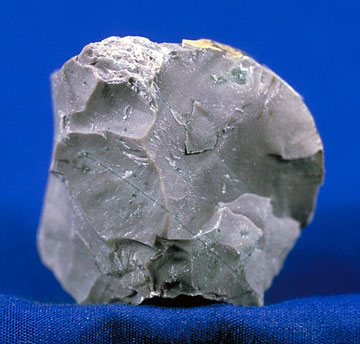
A hard sedimentary rock of microscopic quartz. Dark nodules in chalk are called flint.
Photo: Unknown, Public domain
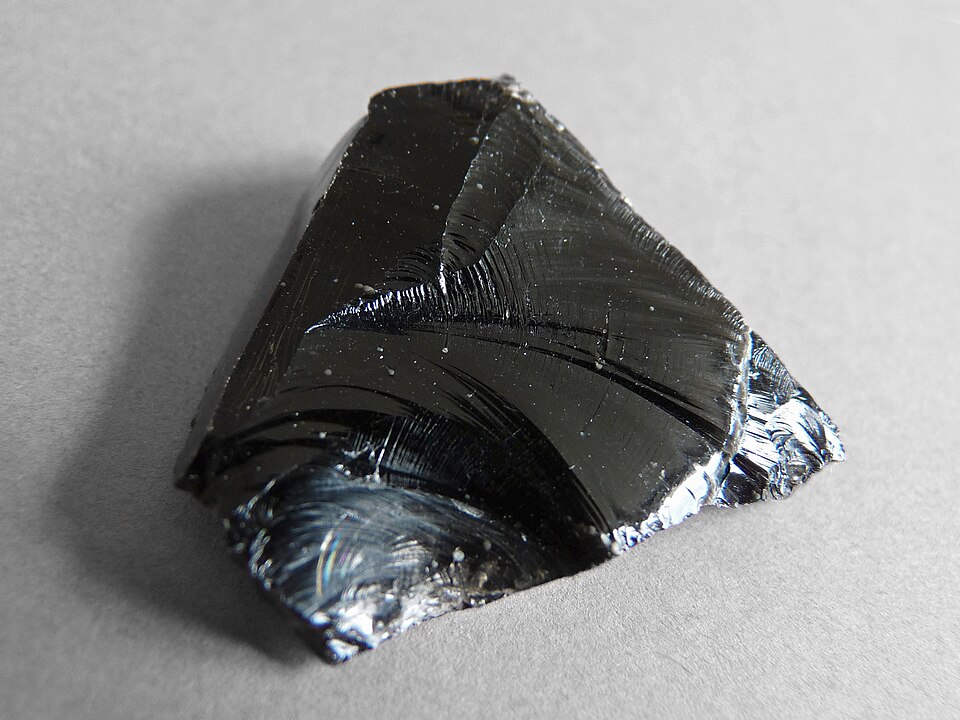
Natural volcanic glass, formed when silica-rich lava cools so fast that crystals have no time to grow.
Photo: Ji-Elle It feels nice and warm It feels like a love storm, CC BY-SA 3.0
Quick tests
- Hardness: Chert is clearly harder: Mohs 6.5–7 versus 5–5.5.
Key differences
- Obsidian is glassier and softer.
Side by side
| Property | Chert | Obsidian |
|---|---|---|
| Type | Sedimentary rock | Igneous rock |
| Mohs hardness | 6.5–7 | 5–5.5 |
| Luster | Waxy to dull | Glassy |
| Colors | Gray, Black, Brown, White | Black, Brown, Red |
| Crystal system / structure | Microcrystalline quartz | Glassy |
| Specific gravity | 2.5–2.7 | 2.35–2.6 |
| Found in | Flint Ridge, Ohio; Alibates, Texas | Glass Buttes, Oregon; Yellowstone, Wyoming |
Properties that are the same for both are grayed out.
How to identify chert
- Breaks with smooth, curved fractures and sharp edges.
- Waxy luster on fresh breaks.
- Scratches glass.
- Sparks when struck against steel.
Structure: Microcrystalline quartz
Full Chert guide →How to identify obsidian
- Shiny, glass-like and usually black.
- Curved, shell-shaped (conchoidal) fractures with razor-sharp edges.
- Thin edges are translucent brown or gray.
- May show white 'snowflakes' or a gold/rainbow sheen.
Structure: Glassy
Full Obsidian guide →More comparisons
Could you tell them apart from a blurry close-up?
Play today's Rocksday