 Rocksday
Chalcopyrite vs Native Copper
How to tell them apart
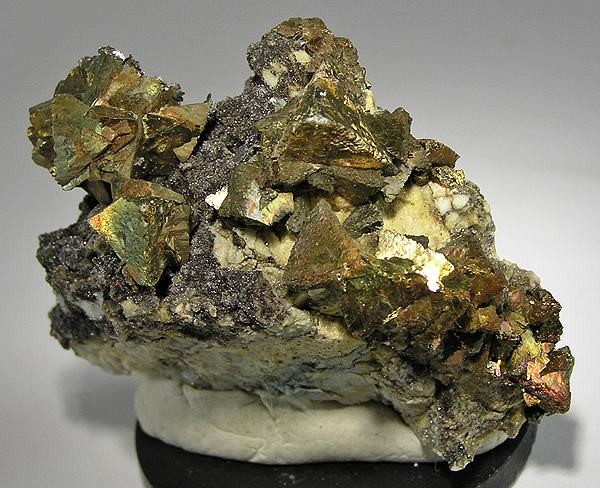
Copper iron sulfide and the world's most important copper ore. Brassy yellow, often tarnished to rainbow purples and blues.
Photo: Robert M. Lavinsky, CC BY-SA 3.0
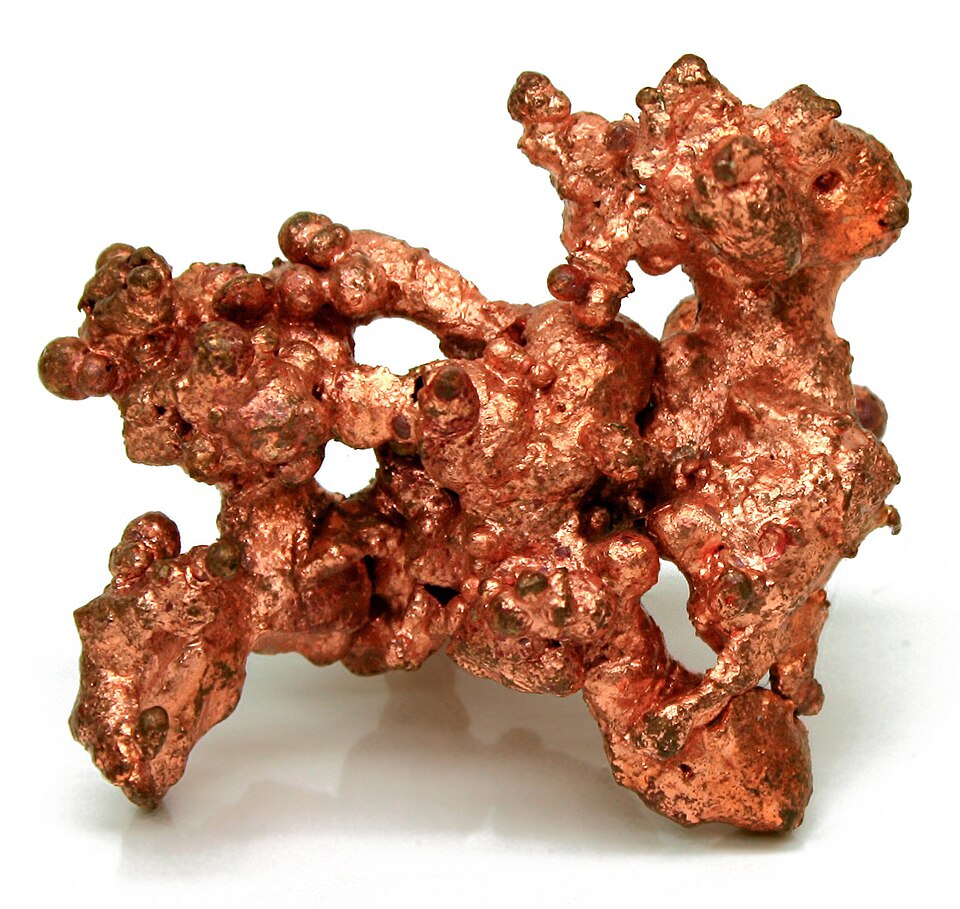
Copper as a pure metal, often in branching, tree-like masses. Fresh surfaces are salmon-pink; old ones tarnish brown or green.
Photo: Native_Copper_Macro_Digon3.jpg: “Jonathan Zander (Digon3)" derivative work: Materialscientist (talk), CC BY-SA 3.0
Quick tests
- Streak (rub on unglazed porcelain): Chalcopyrite leaves a greenish black streak; Native Copper leaves copper red.
- Heft: Native Copper feels noticeably heavier for its size (specific gravity 8.9–8.95 vs 4.1–4.3).
Key differences
- Chalcopyrite is brass-yellow and brittle.
Side by side
| Property | Chalcopyrite | Native Copper |
|---|---|---|
| Type | Mineral | Mineral |
| Mohs hardness | 3.5–4 | 2.5–3 |
| Luster | Metallic | Metallic |
| Streak | Greenish black | Copper red |
| Colors | Gold | Orange, Brown, Green |
| Crystal system | Tetragonal | Cubic |
| Specific gravity | 4.1–4.3 | 8.9–8.95 |
| Formula | CuFeS₂ | Cu |
| Found in | Chile; Peru | Keweenaw Peninsula, Michigan; Arizona |
Properties that are the same for both are grayed out.
How to identify chalcopyrite
- Deeper, greener yellow than pyrite.
- Iridescent tarnish on older surfaces.
- A knife scratches it (pyrite resists).
- Greenish-black streak.
Crystal system: Tetragonal
Full Chalcopyrite guide →How to identify native copper
- Copper-red where scratched; brown or green tarnish elsewhere.
- Heavy and malleable — it bends.
- Branching, wiry or nugget shapes.
- Shiny copper-red streak.
Crystal system: Cubic
Full Native Copper guide →More comparisons
Could you tell them apart from a blurry close-up?
Play today's Rocksday