 Rocksday
Carnelian vs Precious Coral
How to tell them apart
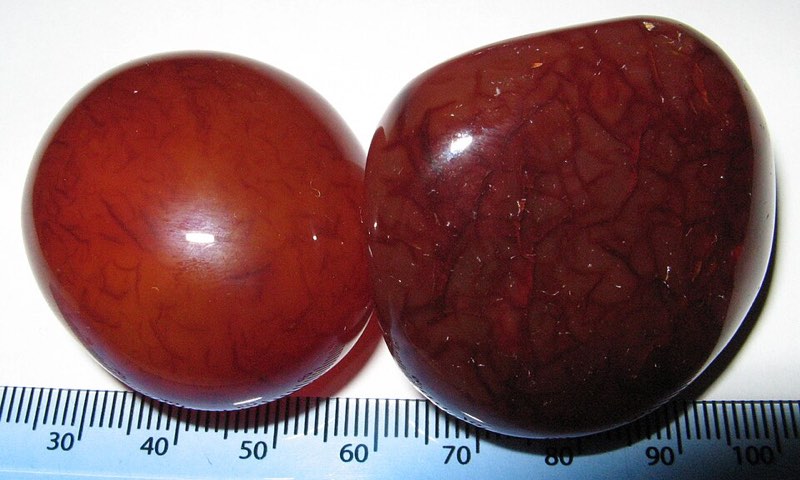
Translucent orange-red chalcedony colored by iron oxide.
Photo: Hyperdeath, CC BY-SA 4.0
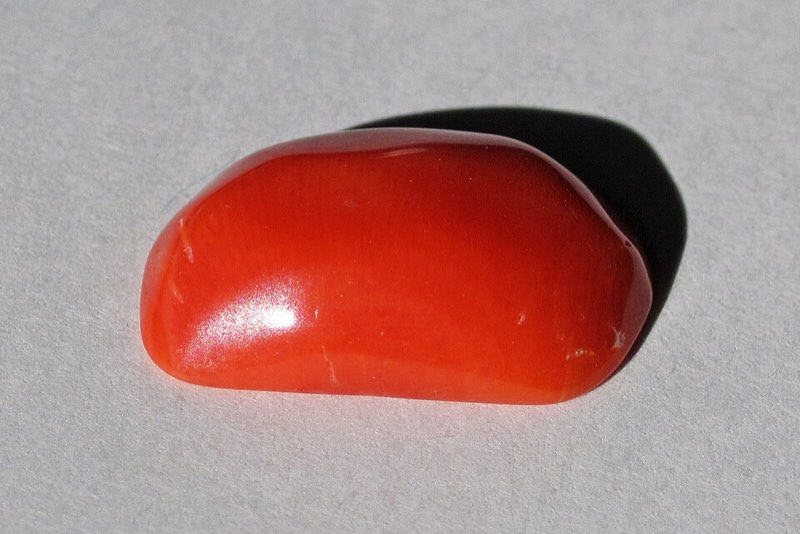
The calcite skeleton of slow-growing Corallium species, polished into red and pink beads.
Photo: James St. John, CC BY 2.0
Quick tests
- Scratch glass: Carnelian scratches glass (Mohs 6.5–7); Precious Coral can't (Mohs 3–4).
- Acid (vinegar or dilute HCl): Precious Coral fizzes; Carnelian doesn't.
Key differences
- Carnelian is translucent and much harder.
Side by side
| Property | Carnelian | Precious Coral |
|---|---|---|
| Type | Mineral | Mineraloid |
| Mohs hardness | 6.5–7 | 3–4 |
| Luster | Waxy to vitreous | Dull to vitreous (polished) |
| Streak | White | — |
| Colors | Orange, Red, Brown | Red, Pink, Orange, White |
| Crystal system / structure | Microcrystalline quartz (chalcedony) | Organic (calcite skeleton) |
| Specific gravity | 2.58–2.64 | 2.6–2.7 |
| Formula | SiO₂ | — |
| Found in | India; Brazil | Mediterranean Sea; Japan |
Properties that are the same for both are grayed out.
How to identify carnelian
- Glows orange-red when held up to light.
- Even color or soft cloudy banding.
- Waxy surface, hard enough to scratch glass.
Crystal system: Microcrystalline quartz (chalcedony)
Full Carnelian guide →How to identify precious coral
- Even red to pink, with faint parallel growth lines.
- Fizzes in acid.
- Branch-shaped rough pieces.
Structure: Organic (calcite skeleton)
Full Precious Coral guide →More comparisons
Could you tell them apart from a blurry close-up?
Play today's Rocksday