 Rocksday
Brucite vs Talc
How to tell them apart
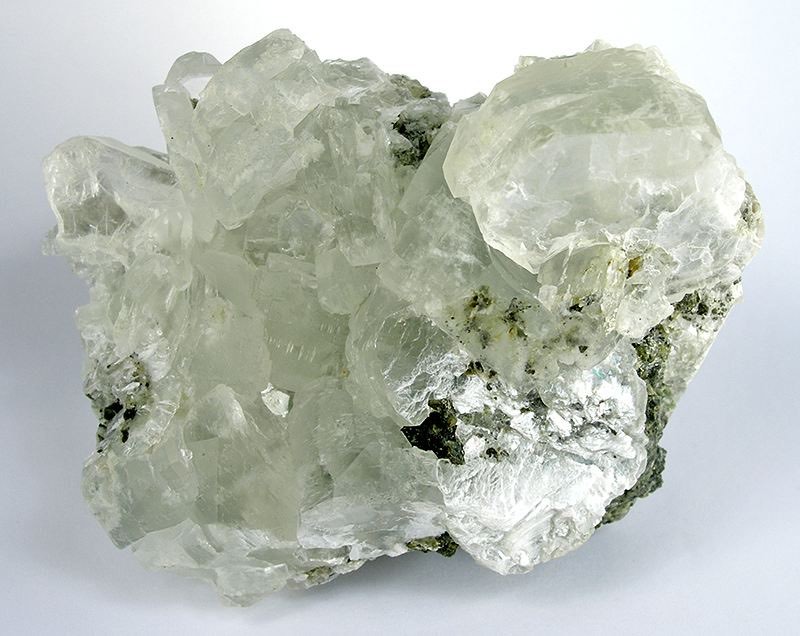
Magnesium hydroxide forming pearly, flexible plates in serpentine and marble.
Photo: Robert M. Lavinsky, CC BY-SA 3.0
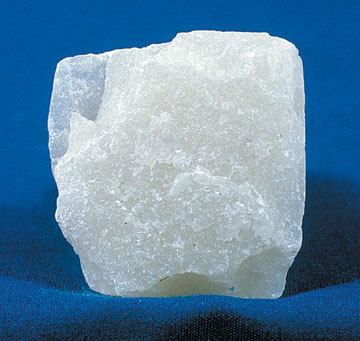
The softest mineral, number 1 on the Mohs scale. It feels soapy or greasy and leaves powder on your fingers.
Photo: Unknown, Public domain
Quick tests
- Hardness: Brucite is clearly harder: Mohs 2.5–3 versus 1.
Key differences
- Talc is softer and feels greasy.
Side by side
| Property | Brucite | Talc |
|---|---|---|
| Type | Mineral | Mineral |
| Mohs hardness | 2.5–3 | 1 |
| Luster | Pearly to waxy | Pearly to greasy |
| Streak | White | White |
| Colors | White, Green, Gray | White, Green, Gray |
| Crystal system | Trigonal | Monoclinic |
| Specific gravity | 2.39 | 2.7–2.8 |
| Formula | Mg(OH)₂ | Mg₃Si₄O₁₀(OH)₂ |
| Found in | Pakistan; Quebec, Canada | Vermont; Montana |
Properties that are the same for both are grayed out.
How to identify brucite
- Pearly white to pale green plates.
- Flexible but not elastic flakes.
- Soft.
Crystal system: Trigonal
Full Brucite guide →How to identify talc
- Easily scratched by a fingernail.
- Slippery, soapy feel.
- Pearly sheen on flaky surfaces.
- Flakes don't spring back when bent.
Crystal system: Monoclinic
Full Talc guide →More comparisons
Could you tell them apart from a blurry close-up?
Play today's Rocksday