 Rocksday
Breccia vs Conglomerate
How to tell them apart
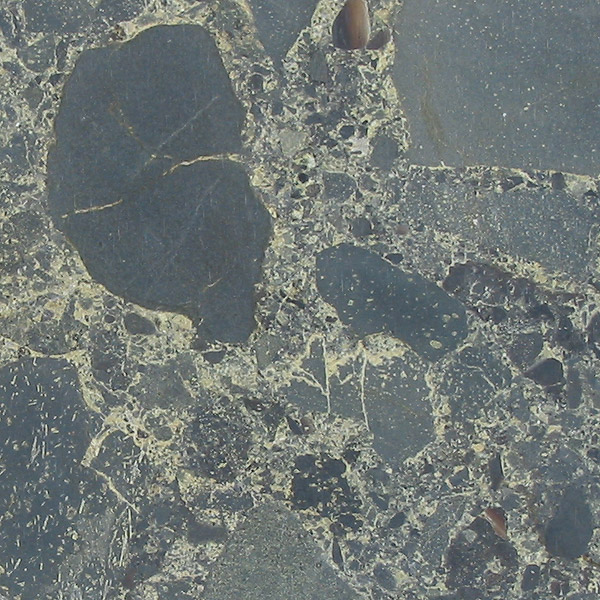
Sharp, broken rock fragments cemented together. It forms where rock shatters — at faults, landslides or impacts.
Photo: No machine-readable author provided. Siim assumed (based on copyright claims)., CC BY-SA 3.0
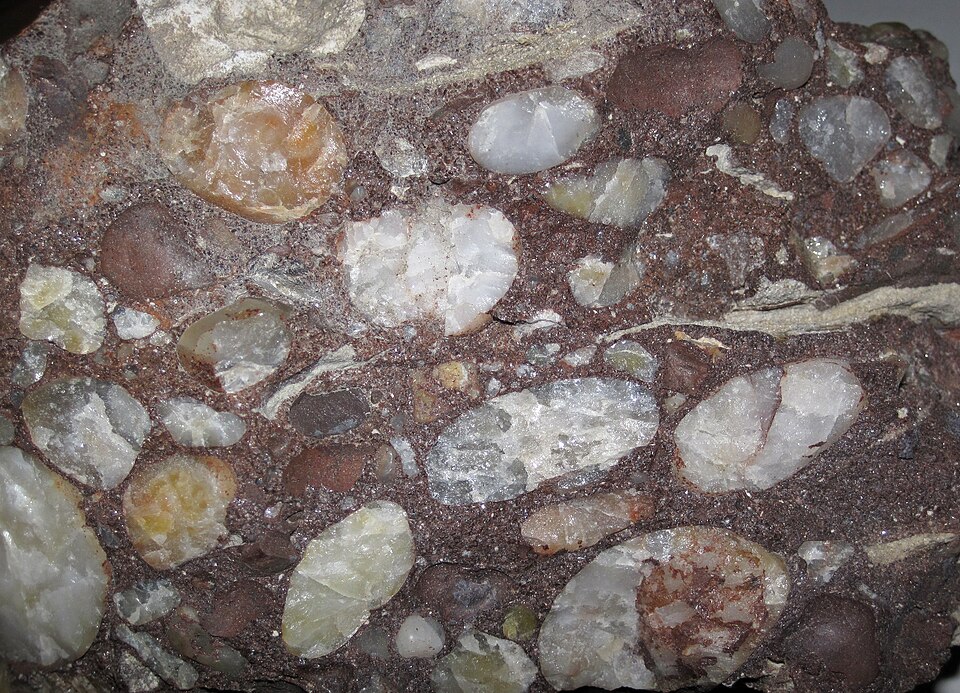
Rounded pebbles and cobbles glued together by finer sand and cement — a fossil riverbed or beach.
Photo: James St. John, CC BY 2.0
Key differences
- Conglomerate's pebbles are rounded.
- Breccia's fragments are angular, not rounded.
Side by side
| Property | Breccia | Conglomerate |
|---|---|---|
| Type | Sedimentary rock | Sedimentary rock |
| Mohs hardness | 5–7 | 5–7 |
| Luster | Dull | Dull |
| Colors | Brown, Gray, Red, White | Brown, Gray, Red |
| Crystal system / structure | Clastic, angular fragments in matrix | Clastic, rounded pebbles in matrix |
| Specific gravity | 2.4–2.8 | 2.4–2.7 |
| Found in | Fault zones worldwide; Sudbury, Ontario | Montserrat, Spain; Kata Tjuta, Australia |
Properties that are the same for both are grayed out.
How to identify breccia
- Angular, broken fragments.
- Fragments set in a finer matrix.
- Fragments often of one rock type.
- Looks like a smashed and glued mosaic.
Structure: Clastic, angular fragments in matrix
Full Breccia guide →How to identify conglomerate
- Contains rounded pebbles larger than 2 mm.
- Pebbles of different rock types.
- Sand or mud fills the gaps.
- Looks like natural concrete.
Structure: Clastic, rounded pebbles in matrix
Full Conglomerate guide →More comparisons
Could you tell them apart from a blurry close-up?
Play today's Rocksday