 Rocksday
Bournonite vs Tetrahedrite
How to tell them apart
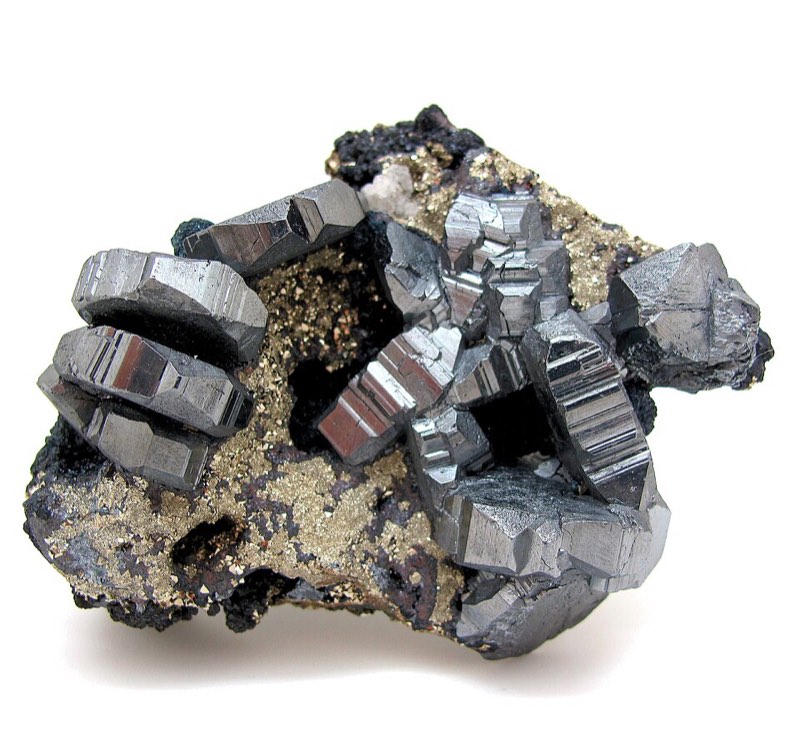
A lead copper antimony sulfide whose twinned crystals look like cogwheels.
Photo: CarlesMillan, CC BY-SA 4.0
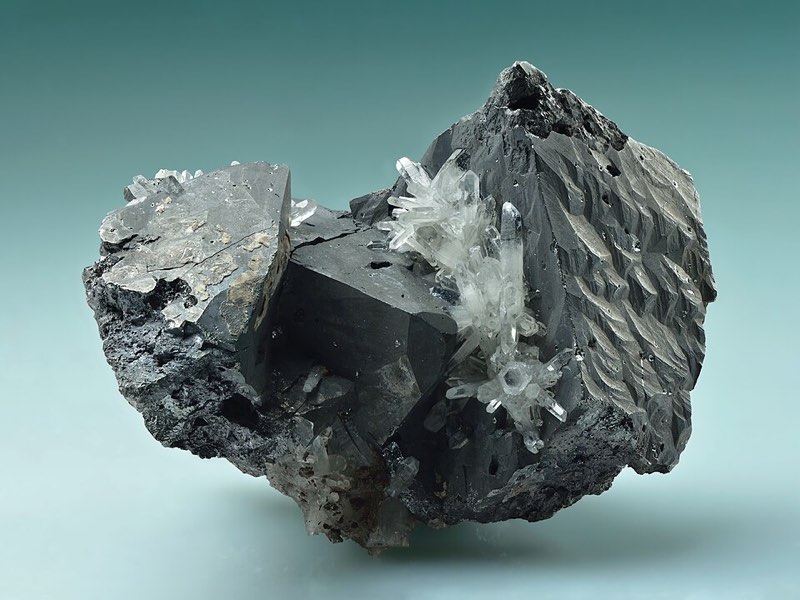
A steel-gray copper antimony sulfide named for its tetrahedral crystals; it often carries silver.
Photo: Ivar Leidus, CC BY-SA 4.0
Quick tests
- Streak (rub on unglazed porcelain): Bournonite leaves a steel gray streak; Tetrahedrite leaves black to brown.
Key differences
- Tetrahedrite forms tetrahedrons.
- Bournonite forms cogwheel-shaped twins.
Side by side
| Property | Bournonite | Tetrahedrite |
|---|---|---|
| Type | Mineral | Mineral |
| Mohs hardness | 2.5–3 | 3.5–4 |
| Luster | Metallic | Metallic |
| Streak | Steel gray | Black to brown |
| Colors | Gray, Black | Gray, Black |
| Crystal system | Orthorhombic | Cubic |
| Specific gravity | 5.7–5.9 | 4.6–5.1 |
| Formula | PbCuSbS₃ | Cu₁₂Sb₄S₁₃ |
| Found in | Cornwall, England; Hunan, China | Peru; Bolivia |
Properties that are the same for both are grayed out.
How to identify bournonite
- Steel-gray crystals twinned into gear-like shapes.
- Metallic and heavy.
- Soft — a knife scratches it.
Crystal system: Orthorhombic
Full Bournonite guide →How to identify tetrahedrite
- Steel-gray tetrahedrons (four-sided pyramids).
- Metallic luster, no cleavage.
- Brownish-black streak.
Crystal system: Cubic
Full Tetrahedrite guide →More comparisons
Could you tell them apart from a blurry close-up?
Play today's Rocksday