 Rocksday
Bismuth vs Native Silver
How to tell them apart
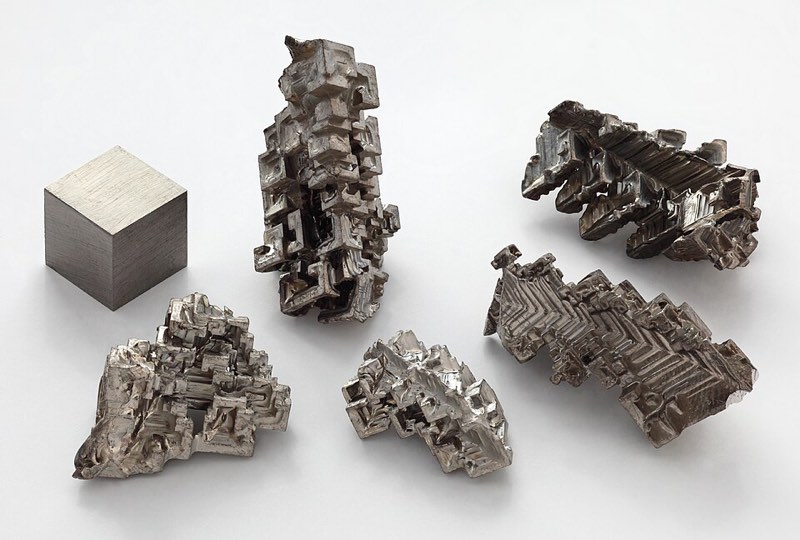
A heavy, pinkish-silver metal. Rainbow staircase crystals sold in shops are lab-grown from melted bismuth.
Photo: Alchemist-hp (talk) (www.pse-mendelejew.de), FAL
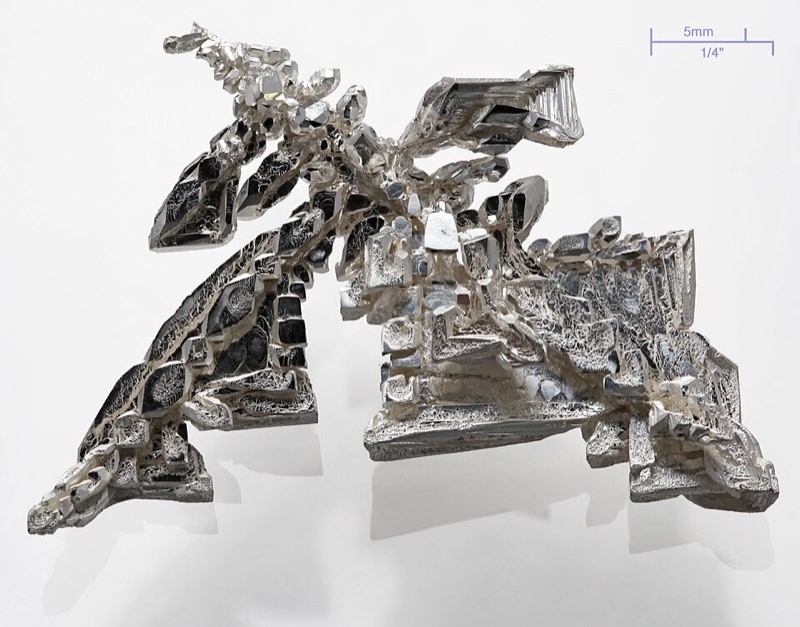
Silver as a pure metal, often in wiry, branching forms that tarnish black.
Photo: Alchemist-hp (talk) (www.pse-mendelejew.de), CC BY-SA 3.0 de
Key differences
- Silver bends and tarnishes black.
Side by side
| Property | Bismuth | Native Silver |
|---|---|---|
| Type | Mineral | Mineral |
| Mohs hardness | 2–2.5 | 2.5–3 |
| Luster | Metallic | Metallic |
| Streak | Silver-white | Silver-white |
| Colors | Silver, Pink | Silver, Black |
| Crystal system | Trigonal | Cubic |
| Specific gravity | 9.7–9.8 | 10.1–11.1 |
| Formula | Bi | Ag |
| Found in | Tasna, Bolivia; Saxony, Germany | Kongsberg, Norway; Keweenaw Peninsula, Michigan |
Properties that are the same for both are grayed out.
How to identify bismuth
- Silvery with a pinkish tint.
- Heavy and brittle, not bendable.
- Shop specimens: iridescent hopper 'staircase' crystals.
Crystal system: Trigonal
Full Bismuth guide →How to identify native silver
- Silvery metal, tarnished gray to black.
- Wires, branches or flakes.
- Bends and is very heavy.
Crystal system: Cubic
Full Native Silver guide →More comparisons
Could you tell them apart from a blurry close-up?
Play today's Rocksday