 Rocksday
Ammolite vs Opal
How to tell them apart
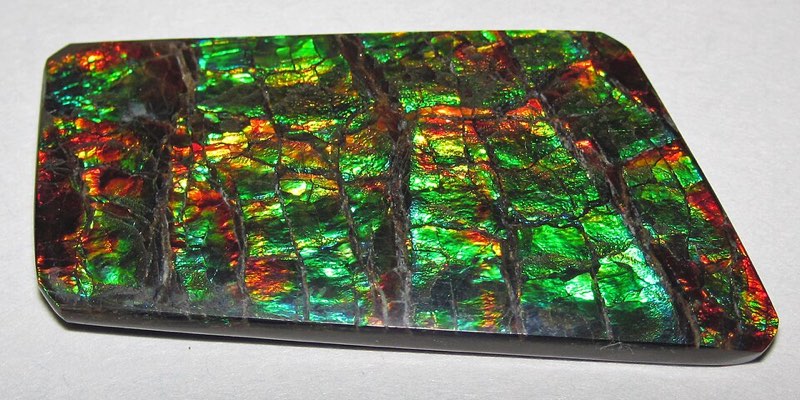
A rare gem made from the shimmering shell layers of fossil ammonites.
Photo: James St. John, CC BY 2.0
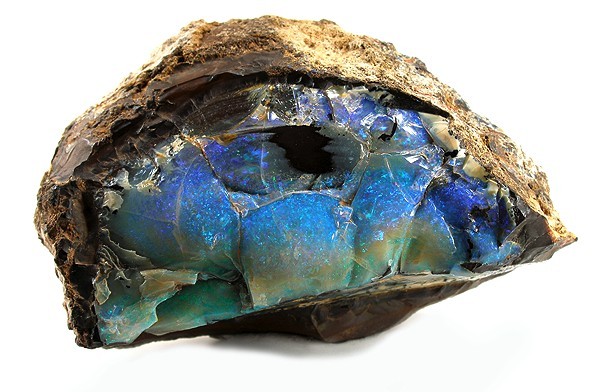
Hydrated silica with no crystal structure. In precious opal, stacked microscopic spheres split light into flashing rainbow patches.
Photo: Robert M. Lavinsky, CC BY-SA 3.0
Quick tests
- Hardness: Opal is clearly harder: Mohs 5.5–6.5 versus 3.5–4.5.
- Texture: Ammolite is a fossil; Opal is a single mineraloid.
Key differences
- Opal's color is in pinpoints, not in shell layers.
Side by side
| Property | Ammolite | Opal |
|---|---|---|
| Type | Fossil | Mineraloid |
| Mohs hardness | 3.5–4.5 | 5.5–6.5 |
| Luster | Vitreous, iridescent | Vitreous to waxy |
| Streak | — | White |
| Colors | Red, Green, Orange, Blue | White, Black, Orange |
| Crystal system / structure | Iridescent ammonite shell (aragonite) | Amorphous |
| Specific gravity | 2.6–2.85 | 1.9–2.3 |
| Formula | — | SiO₂·nH₂O |
| Found in | Southern Alberta, Canada | Coober Pedy, Australia; Lightning Ridge, Australia |
Properties that are the same for both are grayed out.
How to identify ammolite
- Vivid rainbow iridescence in patches.
- Cracked 'dragon-skin' mosaic pattern.
- Usually thin and backed on shale.
Structure: Iridescent ammonite shell (aragonite)
Full Ammolite guide →How to identify opal
- Flashes of spectral color that shift as you turn it.
- Waxy to glassy luster.
- Light in weight for a gemstone.
- Common opal lacks color play and looks milky.
Structure: Amorphous
Full Opal guide →More comparisons
Could you tell them apart from a blurry close-up?
Play today's Rocksday